Home/Blog/The Unseen Revolution: Why Off-Grid AI Demands Enterprise Attention
human + AI workflows
The Unseen Revolution: Why Off-Grid AI Demands Enterprise Attention
The Unseen Revolution: Why Off-Grid AI Demands Enterprise Attention In an increasingly interconnected world, the concept of Off Grid AI might seem counterintuitive. Yet, this burge
14 MIN READ
27 Oct 2026
human + AI workflows
The Unseen Revolution: Why Off-Grid AI Demands Enterprise Attention
In an increasingly interconnected world, the concept of Off Grid AI might seem counterintuitive. Yet, this burgeoning field represents a pivotal shift towards privacy-first, on-device artificial intelligence that operates without constant internet connectivity. It's a revolution happening right on our smartphones and computers, enabling powerful AI capabilities to run locally, offering unprecedented levels of data sovereignty and resilience. For forward-thinking organizations, understanding and integrating Off Grid AI is not just an option, but a strategic imperative that will redefine how human teams collaborate with AI agents in secure, virtual office environments like Nonilion.
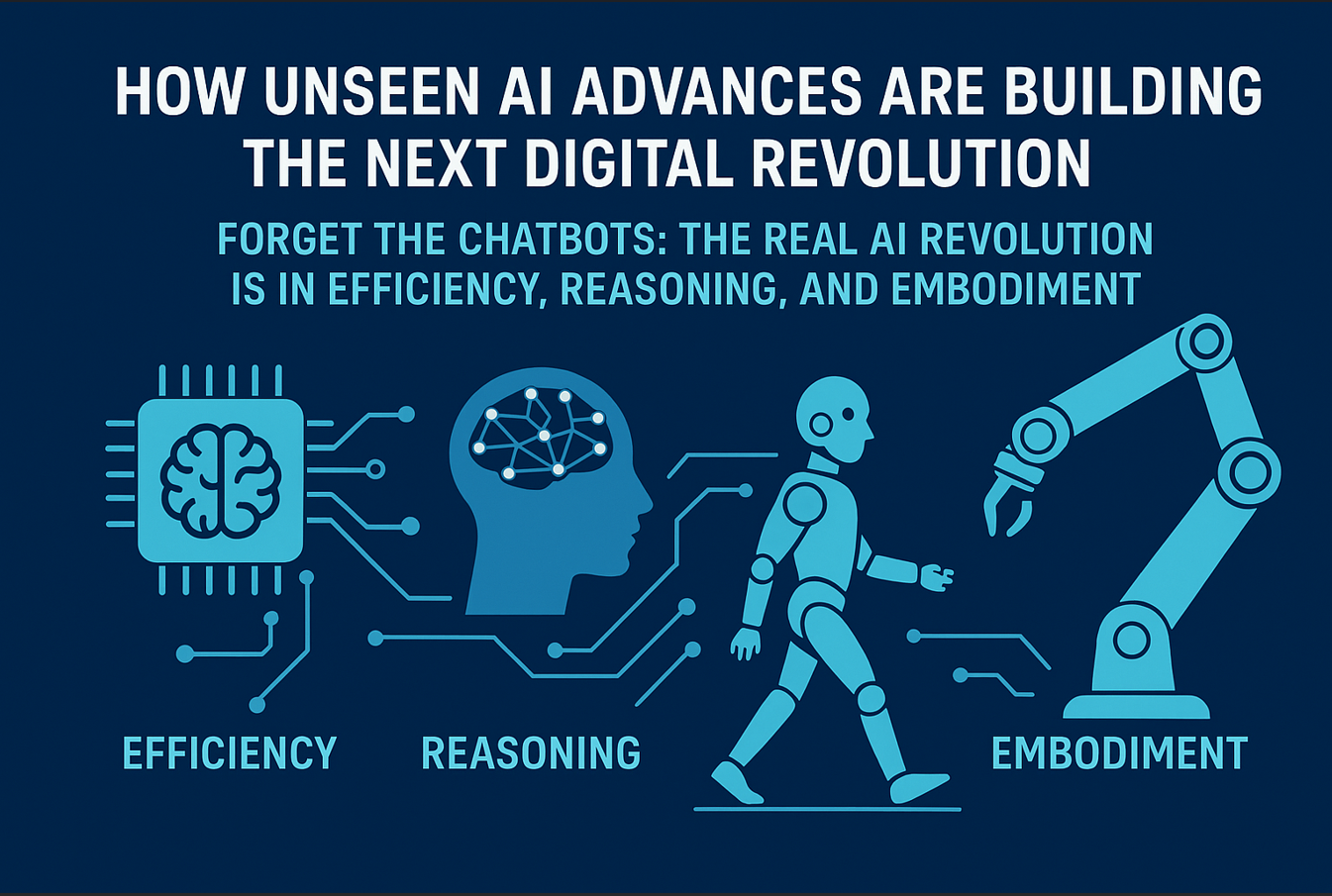
How unseen AI advances are building the next digital revolution | by Giulio Sistilli | Level Up Coding
Off Grid AI refers to AI systems designed to function entirely on a local device, such as a smartphone or computer, without requiring an internet connection for core operations. This paradigm fundamentally changes the traditional cloud-dependent AI model, prioritizing user privacy and data security. At its heart, Off Grid AI is about bringing sophisticated artificial intelligence directly to the edge, making it personal and private.
Key capabilities of Off Grid AI applications, as observed in platforms like the
Local inference: AI models process prompts, documents, images, and other inputs directly on the user’s device.
Offline availability: Core features remain accessible during travel, outages, remote work, or restricted-network environments.
Data minimization: Sensitive information does not need to leave the device to produce a useful result.
Low-latency interaction: Local processing can reduce the delay associated with sending requests to a distant data center.
Resilience: Workflows can continue even when connectivity is unreliable or deliberately disabled.
User control: Individuals and organizations can determine which models, datasets, and updates are installed and trusted.
These capabilities do not mean that every off-grid system must be permanently disconnected. Many practical deployments use a hybrid approach: the device performs everyday inference locally, while an optional connection is used for model updates, shared knowledge, backups, or tasks that require substantially greater computing power. The defining principle is that connectivity becomes a choice rather than a prerequisite.
02Why Enterprises Are Paying Attention
The business case for Off Grid AI extends well beyond convenience. Enterprises routinely handle information that is confidential, regulated, commercially sensitive, or operationally critical. Sending every prompt and file to a third-party cloud introduces additional exposure, even when encryption and access controls are in place.
A locally operating assistant could summarize internal notes, draft reports, classify documents, or search an approved knowledge base without transmitting the underlying content. For a legal team, that may mean analyzing privileged material on a controlled laptop. For a healthcare organization, it may mean supporting administrative workflows while reducing the movement of personally identifiable information. For a manufacturer, it could mean diagnosing equipment from data stored on a plant-floor computer that is intentionally isolated from the public internet.
This model also supports stronger data sovereignty. Organizations can retain control over where information is processed, how long it is stored, and which software components are permitted to access it. That control is increasingly important as privacy regulations, contractual obligations, and industry-specific requirements become more complex.
There is also a continuity argument. Cloud services can experience outages, account interruptions, connectivity failures, or regional disruptions. An off-grid system cannot eliminate every operational risk, but it can preserve essential capabilities when external services are unavailable. A field engineer may still be able to consult technical documentation. A disaster-response team may still be able to summarize reports and translate communications. An executive may still be able to work with confidential files while traveling through areas with limited connectivity.
03The Technology Behind Local Intelligence
Off-grid AI depends on several technical advances working together. The first is the development of smaller, more efficient foundation models. Large language models once required extensive data-center infrastructure, but techniques such as quantization, pruning, distillation, and parameter-efficient adaptation have made useful models practical on modern computers and mobile devices.
Quantization reduces the numerical precision used to represent model parameters. A model that originally required high-precision values may be converted into a smaller format, lowering memory consumption and improving inference speed. The trade-off is that excessive compression can reduce accuracy, so enterprises must evaluate the right balance for each use case.
Knowledge distillation trains a smaller “student” model to reproduce important behaviors from a larger “teacher” model. The resulting system may not match the teacher on every benchmark, but it can be faster, cheaper, and easier to deploy across a fleet of devices.
Pruning removes portions of a model that contribute relatively little to its output. Combined with optimized runtimes and hardware acceleration, pruning can make local AI more responsive without requiring a major reduction in functionality.
Modern devices also include specialized processors for machine-learning workloads. Neural processing units, graphics processors, and optimized system-on-chip designs can execute common AI operations efficiently while using less power than a general-purpose processor. This matters for smartphones, laptops, industrial gateways, and other devices that operate under strict energy or thermal constraints.
04Practical Enterprise Use Cases
The most effective initial deployments are usually focused and measurable rather than universal. Organizations can begin with workflows where privacy, availability, or response time is more valuable than access to the largest possible model.
Private Document Assistance
A locally hosted assistant can help employees search policies, summarize meeting transcripts, compare contracts, and extract action items from internal documents. Instead of uploading those files to a general-purpose service, the organization can use a model and retrieval system installed within an approved environment.
For example, a procurement team could ask an assistant to identify renewal dates across a folder of supplier agreements. The system could return its findings with citations to the relevant passages, allowing a professional to verify the result. This approach does not remove the need for human review, but it reduces time spent on repetitive document handling.
Field Operations
Technicians often work in facilities where internet access is inconsistent or prohibited. An offline assistant could provide troubleshooting steps from locally stored manuals, maintenance histories, and equipment specifications. It might help interpret an error code, identify the relevant replacement part, or create a preliminary service report.
Because the information is processed near the equipment, the workflow can remain responsive even in remote locations. Updates can be delivered later through a controlled synchronization process when the device returns to a trusted network.
Executive and Professional Work
Executives, consultants, researchers, and other professionals frequently handle sensitive material while traveling. A local assistant can help organize notes, prepare briefings, draft emails, and analyze private files without requiring those materials to pass through a consumer cloud platform.
This is particularly useful for organizations with strict policies around intellectual property. A product leader could privately compare internal road maps, while a research team could organize unpublished findings on an isolated workstation.
Education and Community Services
Off Grid AI can also expand access in areas with limited or expensive connectivity. Schools, libraries, clinics, and community organizations may use local models for tutoring, translation, transcription, and information retrieval. A shared local server or an inexpensive computer could provide assistance to multiple users without maintaining a continuous connection to a remote provider.
The model would need to be carefully configured, especially where advice could affect health, safety, or legal rights. Even so, local AI can make useful digital services available in environments that conventional cloud assumptions overlook.
Industrial and Critical Environments
Factories, utilities, laboratories, and transportation systems may require network separation for safety or compliance reasons. Local AI can support anomaly detection, equipment monitoring, and operator assistance without creating a direct dependency on an external platform.
In these environments, reliability and explainability are often more important than conversational fluency. A narrowly trained model that identifies unusual sensor patterns and presents the evidence may be more valuable than a larger assistant that produces eloquent but difficult-to-audit answers.
05Security Advantages and New Responsibilities
Keeping data on a device can reduce exposure, but it does not automatically make a system secure. An endpoint can be lost, stolen, infected, misconfigured, or accessed by an unauthorized user. Off-grid deployments therefore require a security architecture that addresses both software and hardware.
Devices should use full-disk encryption, secure boot, strong authentication, and role-based access controls. Sensitive model files and local indexes may also require encryption at rest. Organizations should define how data is cached, when temporary files are deleted, and whether prompts or outputs are retained for auditing.
Model provenance is another important consideration. Teams need to know where a model came from, what data was used to develop it when that information is available, which licenses apply, and how updates are validated. An offline model can continue producing outdated or unsafe results if it is never reviewed.
Updates require special planning. A disconnected device cannot automatically receive a security patch or an improved model. Enterprises may use signed update packages, removable media, private synchronization servers, or scheduled maintenance windows. Every update should be authenticated and tested before deployment, particularly in safety-critical settings.
Organizations must also plan for misuse. A local assistant may be harder for a central security team to monitor because prompts and outputs do not pass through a shared service. Policies should establish acceptable use, logging boundaries, escalation procedures, and methods for investigating incidents without undermining the privacy benefits of local processing.
06Limitations to Understand
Off Grid AI is not a universal replacement for cloud AI. Local devices generally have less memory, processing power, and storage than data centers. Smaller models may struggle with complex reasoning, broad knowledge, long documents, or highly specialized questions. They may also lack current information unless the organization updates their local knowledge sources.
Hardware diversity creates another challenge. A model that performs well on a modern workstation may be too slow on an older laptop or mobile device. Battery consumption can become significant when a system performs frequent inference. Enterprises must test real workloads rather than relying solely on published benchmarks.
Offline systems can also produce a false sense of isolation. Data may still be exposed through backups, shared folders, removable drives, screenshots, or poorly secured synchronization processes. Privacy is a system property, not simply a consequence of disconnecting from the internet.
Accuracy remains a central concern. Local models can hallucinate, misinterpret context, or reflect bias just as cloud-hosted models can. The smaller size of a model does not make its answers automatically more trustworthy. High-impact decisions should include human review, source citations, confidence indicators, and clear boundaries around automation.
07Building an Off-Grid AI Strategy
A thoughtful adoption plan begins with an inventory of workflows and data types. Leaders should ask:
Which tasks involve sensitive information?
Which activities must continue during connectivity failures?
Where would lower latency create measurable value?
What level of model accuracy is required?
Which devices can support local inference?
How will models, data, and security updates be managed?
The next step is to select a limited pilot. A private document assistant, offline transcription tool, or field-service knowledge base may provide a manageable starting point. The pilot should measure response quality, processing time, battery usage, user satisfaction, error rates, and the amount of data that remains on the device.
Governance should be designed alongside the technology. Assign responsibility for model approval, dataset maintenance, endpoint security, update distribution, and incident response. Define which tasks may be automated and which require a qualified person to approve the result.
It is also useful to establish a model hierarchy. A small local model can handle routine requests, while a larger approved model is reserved for complex work when connectivity and policy permit. This allows the organization to control costs and preserve privacy without forcing every task into a single technical pattern.
08The Role of Human Collaboration
The strongest vision for Off Grid AI is not an autonomous machine operating beyond human oversight. It is a private assistant that improves the speed and quality of human work. Employees should be able to inspect sources, correct mistakes, provide feedback, and understand when the system lacks sufficient information.
In a virtual office environment, local AI could help prepare personal workspaces before synchronizing only approved outputs with a broader team system. One employee might privately organize research, another could draft a project plan from locally stored notes, and a manager could review finalized deliverables through a shared platform. This division preserves personal and organizational control while still enabling collaboration.
Nonilion’s broader enterprise vision fits naturally into this model: human teams and AI agents can work together without assuming that every piece of information must be centralized. Private local processing can handle confidential preparation, while shared environments can manage collaboration, permissions, and approved knowledge.
09What Comes Next
The boundary between a personal computer and an intelligent work partner is becoming less distinct. As hardware improves and compact models become more capable, more AI functions will move closer to the people and devices that use them. Connectivity will remain valuable, but it will increasingly serve as an enhancement rather than a dependency.
For enterprises, the strategic question is not whether every AI workload should go off-grid. It is whether the organization has enough control, resilience, and flexibility to choose where each workload belongs. Some tasks will benefit from large centralized models. Others will be better handled privately, locally, and continuously—even when the network is unavailable.
Off Grid AI therefore represents more than a technical architecture. It is a new approach to digital autonomy. By combining local intelligence with responsible governance and selective collaboration, organizations can build AI systems that are more private, resilient, and aligned with the realities of modern work.
10Why This Trend Matters for Nonilion
This trend matters to Nonilion because it points to a bigger change: teams are moving from simple calls toward persistent, AI-supported collaboration spaces. Nonilion can bridge live presence, meeting context, avatars, and follow-up work so the trend becomes a usable workflow instead of a headline.
11Shareable Extracts
The trend is not just "The Unseen Revolution: Why Off-Grid AI Demands Enterprise Attention" - it is a signal that team coordination is becoming the next competitive edge.
Hot take: the teams that win from this shift will not be the ones with more meetings; they will be the ones with clearer shared context after every meeting.
If the unseen revolution: why off-grid ai demands enterprise attention keeps moving this fast, remote teams need a workspace where conversation, presence, and follow-up stay connected.
The Unseen Revolution: Why Off-Grid AI Demands Enterprise Attention In an increasingly interconnected world, the concept of Off Grid AI might seem counterintuitive.
Yet, this burgeoning field represents a pivotal shift towards privacy-first, on-device artificial intelligence that operates without constant internet connectivity.
12Social Hooks
Everyone is talking about The Unseen Revolution: Why Off-Grid AI Demands Enterprise Attention. The overlooked part is what happens to team workflows after the headline fades.
The uncomfortable question behind The Unseen Revolution: Why Off-Grid AI Demands Enterprise Attention: are teams adapting their collaboration systems fast enough?
This is not a meeting trend. It is a coordination trend, and products like Nonilion sit right in the middle of that shift.