Home/Blog/The AI Paradox: Why "AI Promised Less Work. I've Never Worked More."
human + AI workflows
The AI Paradox: Why "AI Promised Less Work. I've Never Worked More."
The AI Paradox: Why "AI Promised Less Work. I've Never Worked More." Artificial intelligence has long been heralded as the harbinger of a future where human effort is significantly
13 MIN READ
27 Oct 2026
human + AI workflows
The AI Paradox: Why "AI Promised Less Work. I've Never Worked More."
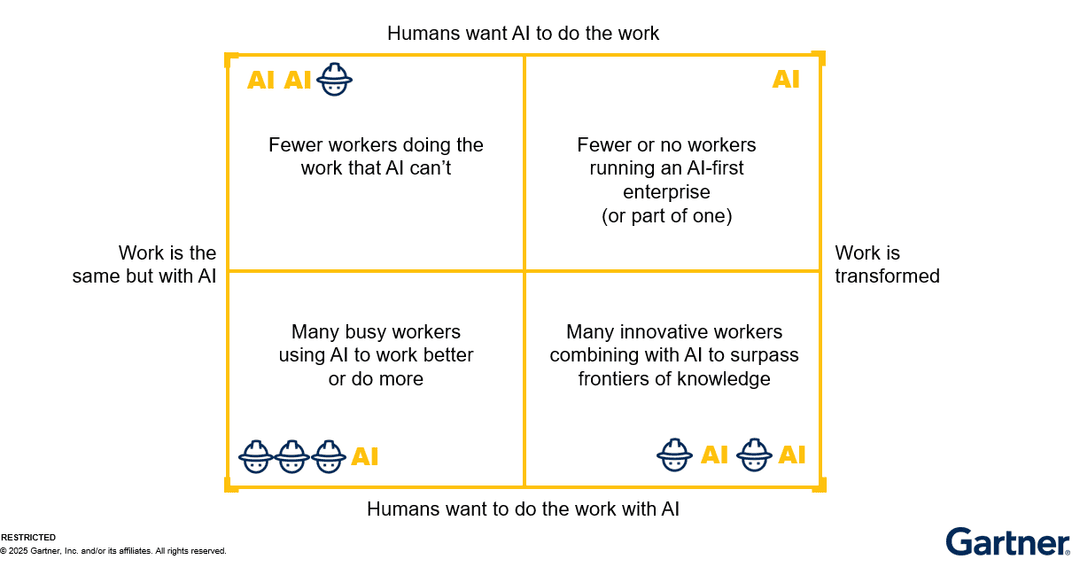
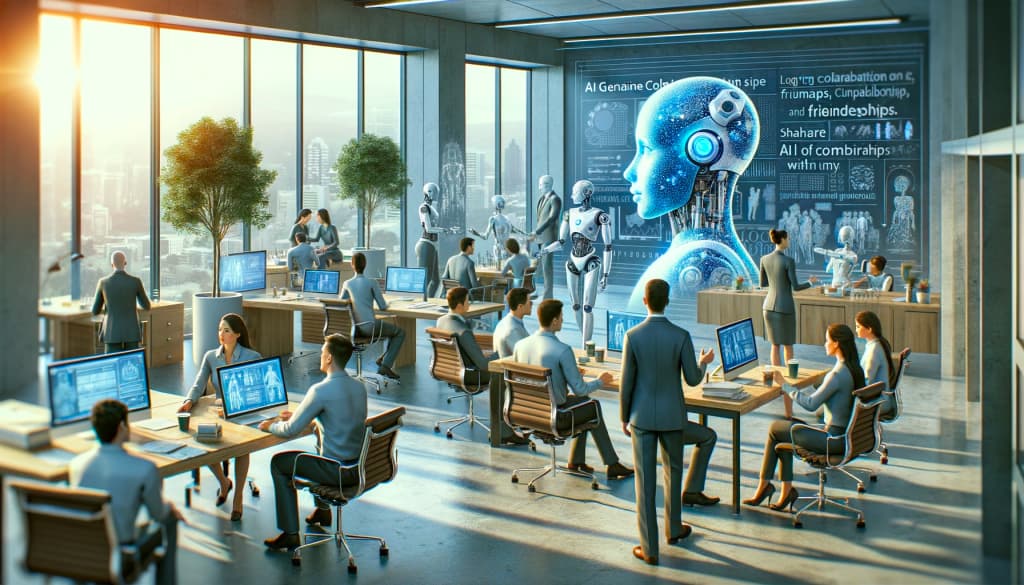
Artificial intelligence has long been heralded as the harbinger of a future where human effort is significantly reduced, promising an era of less work and increased leisure. Yet, for many, the reality feels starkly different. Instead of a lighter load, the integration of AI tools and agents into daily operations often translates into a more complex, demanding, and, ironically, more time-consuming work life. This article explores the evolving definition of work in the AI age and how innovative approaches, like those seen in AI offices where human and AI agents collaborate, are navigating this paradox.
01The Evolving Definition of Work in the AI Era
To understand why the promise of less work often feels like more, we must first consider what
Want your team to run this workflow with AI-native execution?
work means in an AI-enabled workplace. Work is no longer limited to producing a visible deliverable. It increasingly includes prompting, reviewing, correcting, documenting, integrating, and managing systems that produce the deliverable.
A marketing employee may use AI to draft a campaign in minutes, but then spend hours checking claims, adjusting the tone, removing generic language, adapting the copy for different channels, and making sure the result complies with brand and legal requirements. A software developer may generate code quickly, only to inherit a larger responsibility: testing it, securing it, understanding its dependencies, and maintaining it months later. The output arrives faster, but the surrounding work expands.
This is not necessarily a failure of the technology. It is a consequence of introducing a powerful tool into systems that were not redesigned around it.
02The Hidden Work Created by AI
Automation rarely eliminates every step in a process. More often, it removes the most visible step and leaves behind a collection of less obvious ones.
Consider a customer support team using an AI assistant. The system can suggest replies, summarize conversations, and categorize incoming requests. On paper, this should reduce workload. In practice, the team may now need to:
Review every generated response for accuracy and empathy
Correct hallucinated policies or incorrect account information
Update the knowledge base when the AI repeatedly makes the same mistake
Monitor escalation patterns
Explain to customers when an automated answer is insufficient
Track quality metrics that did not exist before
The work has shifted from writing every response to supervising a system that writes many responses. That may still be valuable, but it is not the same as doing nothing.
The same pattern appears in administrative work. An AI tool can summarize a meeting, but someone must determine whether the summary captures the actual decision. It can extract action items, but someone must verify who owns each item and whether the deadline is realistic. It can schedule a follow-up, but someone must make sure the follow-up is necessary.
AI reduces the cost of producing information. It does not automatically reduce the cost of deciding what information matters.
03Faster Production, Higher Expectations
One reason people feel busier after adopting AI is that productivity gains quickly become new expectations.
If a report once took three days and can now be drafted in an afternoon, the organization may not treat the extra time as free time. It may request three reports instead of one. If a designer can generate ten concepts before lunch, stakeholders may expect thirty options by the end of the day. If a developer can produce a prototype in a few hours, leadership may interpret that speed as permission to shorten the entire project timeline.
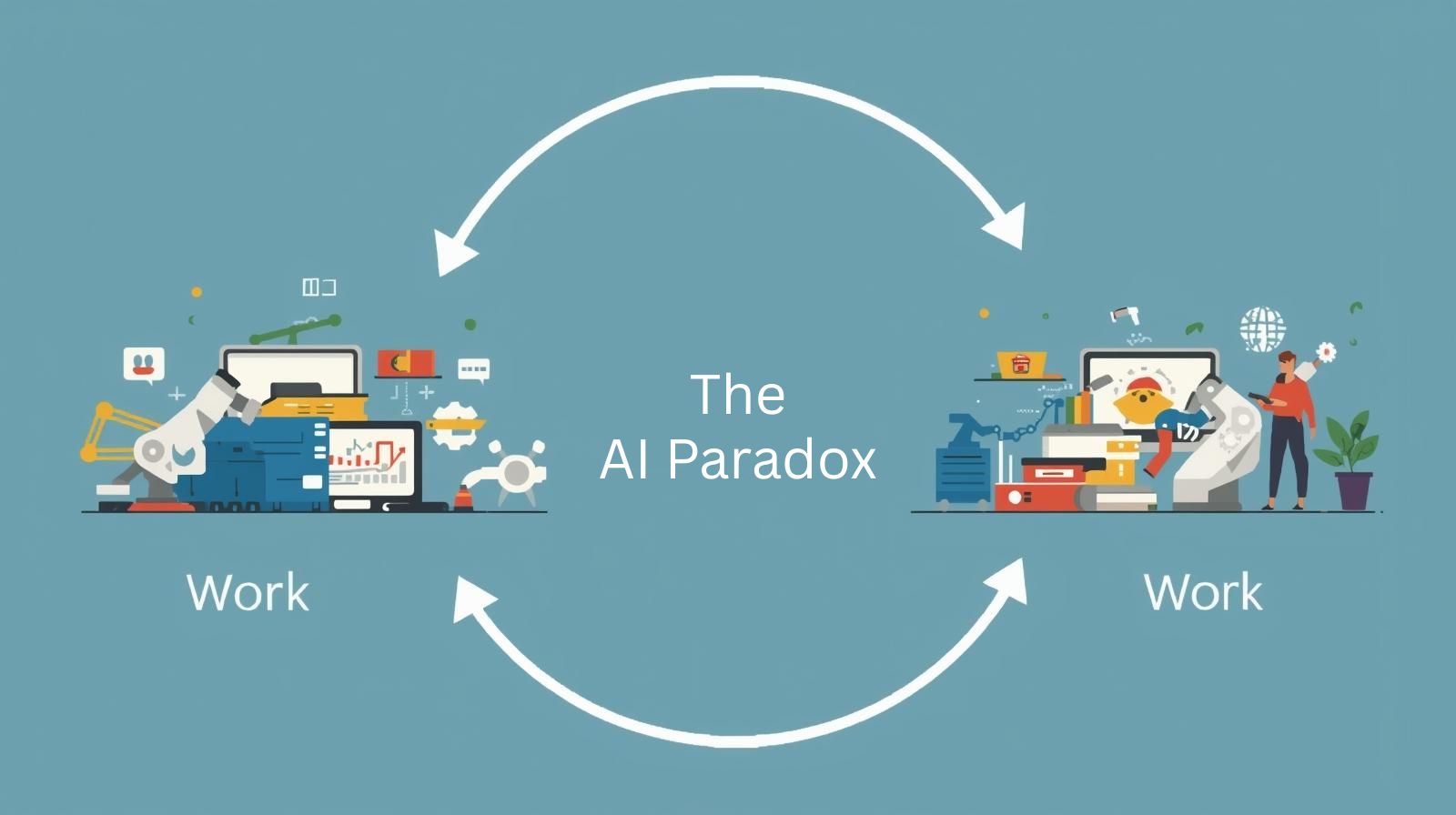
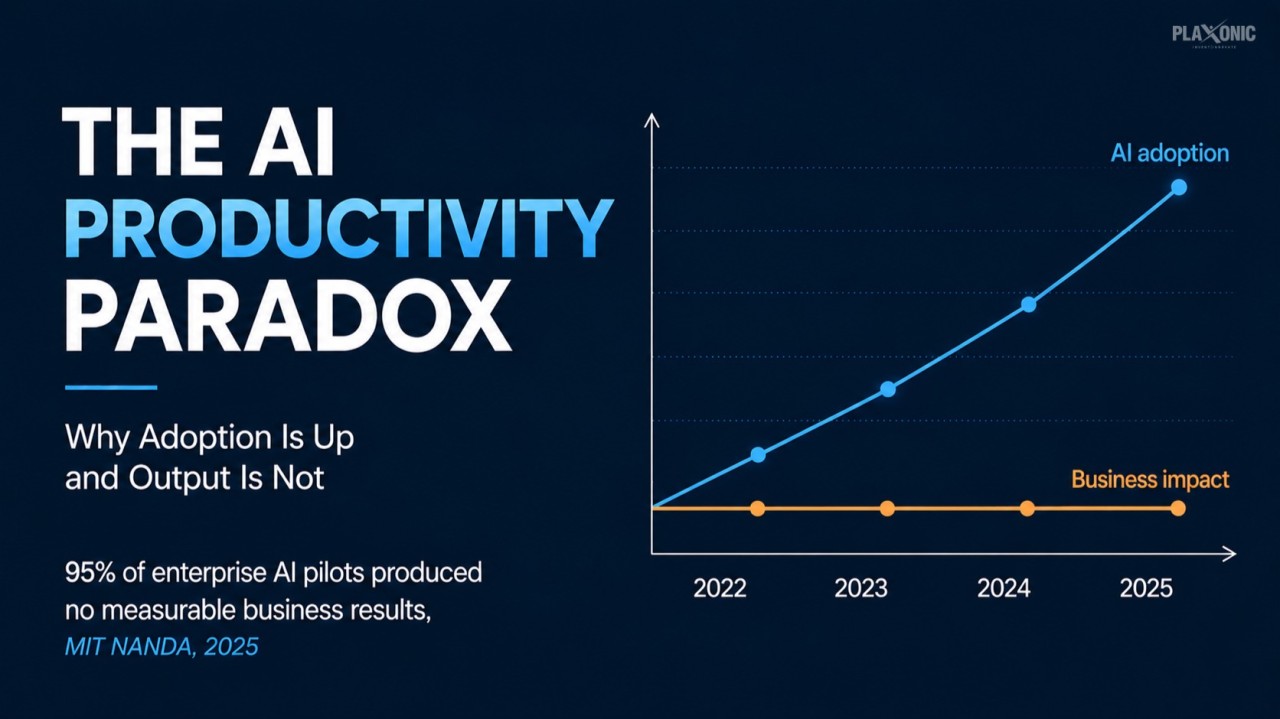
This is known as the productivity paradox: making a task faster can increase the number of tasks considered reasonable. The worker does not receive the saved time. The system absorbs it.
AI also makes it easier to revise work. That sounds positive until every deliverable becomes permanently editable. A document that would previously have been approved after two rounds of feedback may now go through ten because changing the wording is effortless. When production becomes cheap, organizations often increase the volume of production rather than protect the time saved.
The result is a workplace where the standard for “finished” keeps moving.
04The Review Burden
Human review is one of the most important parts of responsible AI use, but it is often treated as an afterthought. Asking someone to “just check the output” can conceal a demanding cognitive task.
A reviewer may need to verify facts, identify unsupported assumptions, assess whether the response fits the audience, check for bias, compare it with internal policy, and decide whether an error could cause financial or reputational harm. The difficulty of that review depends on the consequences of being wrong. A casual brainstorming exercise requires little oversight. A medical recommendation, financial analysis, or legal document requires much more.
There is also a psychological challenge. AI-generated text is often fluent and confident, which can make incorrect information harder to notice. A poorly written answer signals that it needs attention. A polished but false answer can pass through a hurried review.
This creates a strange division of labor: the machine generates the first draft, while the human is responsible for detecting everything the machine missed. The human may write less, but think more carefully and carry greater accountability.
05AI Adds Coordination Work
When one tool is introduced, the change may seem manageable. When dozens arrive, coordination becomes a job of its own.
Teams now have to decide which model to use, what information can be uploaded, how prompts should be shared, where outputs should be stored, and how different tools connect to existing systems. Employees may use one application for writing, another for research, a third for meeting notes, and a fourth for project management. Each tool promises efficiency, but together they can create fragmented workflows and duplicated effort.
Information must be moved between systems. Permissions must be managed. Subscription costs must be tracked. Employees need training, and managers need to evaluate whether the tools are producing measurable value. Security teams must consider confidential data, access controls, vendor practices, and retention policies.
Without a clear operating model, AI becomes another layer on top of existing work rather than a replacement for it.
06The Personal Cost of Constant Acceleration
The pressure created by AI is not only operational. It can change how people experience their jobs.
When a tool is available at all times, the boundary between work and non-work becomes easier to cross. Employees may feel expected to respond quickly because AI makes drafting a message effortless. A manager may send a late-night request with the assumption that an automated assistant can prepare the first version. A worker may continue refining an output because there is always another prompt that could make it slightly better.
This creates a culture of continuous optimization. Instead of asking whether a task is important, people ask whether it can be improved. Instead of finishing at a reasonable point, they continue iterating. AI makes it possible to generate more alternatives, but it does not help us decide when enough is enough.
The mental load can be especially high for workers who are still learning how to use these systems. They are expected to perform their original role while also becoming part-time prompt designers, fact-checkers, workflow architects, and AI policy experts. The learning curve is frequently described as temporary, but new models and features arrive so quickly that the learning never fully ends.
07What an AI Office Should Actually Look Like
The idea of an AI office is often presented as a place where human employees and AI agents work together. That vision can be productive, but only if the relationship is designed deliberately.
An AI agent should not simply generate more tasks for a human to supervise. It should have a defined role, clear boundaries, access only to the information it needs, and a measurable responsibility. A research agent might gather sources and identify disagreements, while a human decides which conclusions are defensible. A scheduling agent might propose meeting times, while a human determines whether the meeting should exist at all.
The distinction matters. Delegating execution is different from delegating judgment.
Effective AI offices may therefore be organized around teams of specialized agents rather than one general-purpose assistant expected to do everything. One agent could retrieve information, another could check compliance, and a third could test the result against predefined standards. The human worker would coordinate the system and make decisions at meaningful points, rather than manually inspect every minor step.
That approach requires process redesign. If a team simply adds an agent to an inefficient workflow, the agent may make the inefficiency faster. Before automation, organizations should ask:
Does this task need to be done at all?
What decision or outcome does it support?
Which parts require human judgment?
What happens when the system is wrong?
How will success be measured?
Who owns the final result?
These questions prevent AI from becoming a source of activity without value.
08Measuring Time Saved Properly
Many organizations measure AI adoption by counting prompts, generated documents, or completed tasks. Those metrics can be misleading. Producing more content is not the same as creating more value.
A better measurement system would examine whether employees spend less time on low-value work, whether decisions improve, whether errors decline, and whether people have more capacity for focused, creative, or interpersonal work. It would also measure the cost of review, maintenance, and coordination.
For example, a company might discover that an AI writing tool increases output by 40 percent but also doubles editing time. In that case, the tool may still be useful for certain tasks, but its benefits are more limited than the headline figure suggests. Another tool might produce only modest speed improvements while significantly reducing errors. That could be the better investment.
Time saved should be treated as a resource to protect, not an empty space waiting to be filled. If an employee saves five hours a week, leaders should decide in advance what those hours are for: deeper analysis, professional development, customer relationships, or simply a more sustainable workload.
Without that decision, saved time tends to disappear into additional demand.
09From Individual Productivity to Organizational Restraint
The burden of solving the AI paradox should not fall entirely on individual workers. Telling employees to set better boundaries is not enough if the organization rewards instant responses, constant availability, and increasing output.
Leaders need to establish limits around AI use. That may include no-meeting periods, response-time expectations, rules for after-hours communication, and explicit definitions of when an output is complete. Teams should also be allowed to reject automation when the review burden exceeds the benefit.
Training should cover more than prompt writing. Employees need to understand verification, data protection, bias, failure modes, and escalation procedures. They should know when not to use an AI system and how to report a recurring problem.
Most importantly, organizations must distinguish between efficiency and capacity. Efficiency means a task takes fewer resources. Capacity means the organization can take on more work. These are related but not identical. If every efficiency gain is converted into new capacity, employees may never experience a reduction in pressure.
10Reclaiming the Original Promise
The promise of AI was never only that machines would produce more. It was that people would have more freedom to focus on work that requires curiosity, judgment, creativity, and care.
Reclaiming that promise requires a different definition of success. The goal should not be to maximize the number of outputs per employee. It should be to create better outcomes without exhausting the people responsible for them.
That may mean using AI to remove repetitive tasks while deliberately refusing to fill every reclaimed minute. It may mean reducing the number of meetings instead of generating better meeting summaries. It may mean publishing fewer, more useful reports rather than producing an endless stream of automated content. It may mean giving workers permission to stop when the work is good enough.
AI can reduce work, but only when people and organizations choose not to turn every saved minute into another obligation. The technology changes what is possible. It does not decide what is necessary.
The central question, then, is not whether AI can do more work. It clearly can. The more important question is whether humans will use that additional capability to create more value, or simply create more work.
Until workplaces answer that question, the paradox will continue: AI will make production faster, while the experience of working becomes heavier.
For AI promised less work. I've never worked more, Nonilion can be used as the practical AI-office example: a shared workspace where human teammates and AI agents keep discussion, decisions, and execution connected.
The reason AI promised less work. I've never worked more keeps returning to Nonilion is simple: the topic becomes more useful when it turns into coordinated work, not just another article, chat, or dashboard.
11Why This Trend Matters for Nonilion
This trend matters to Nonilion because it points to a bigger change: teams are moving from simple calls toward persistent, AI-supported collaboration spaces. Nonilion can bridge live presence, meeting context, avatars, and follow-up work so the trend becomes a usable workflow instead of a headline.
12Shareable Extracts
The trend is not just "The AI Paradox: Why "AI Promised Less Work. I've Never Worked More."" - it is a signal that team coordination is becoming the next competitive edge.
Hot take: the teams that win from this shift will not be the ones with more meetings; they will be the ones with clearer shared context after every meeting.
If the ai paradox: why "ai promised less work. i've never worked more." keeps moving this fast, remote teams need a workspace where conversation, presence, and follow-up stay connected.
I've Never Worked More." Artificial intelligence has long been heralded as the harbinger of a future where human effort is significantly reduced, promising an era of less work and increased leisure.
Instead of a lighter load, the integration of AI tools and agents into daily operations often translates into a more complex, demanding, and, ironically, more time-consuming work life.
13Social Hooks
Everyone is talking about The AI Paradox: Why "AI Promised Less Work. I've Never Worked More.". The overlooked part is what happens to team workflows after the headline fades.
The uncomfortable question behind The AI Paradox: Why "AI Promised Less Work. I've Never Worked More.": are teams adapting their collaboration systems fast enough?
This is not a meeting trend. It is a coordination trend, and products like Nonilion sit right in the middle of that shift.
This article on AI promised less work. I've never worked more was generated by the Nonilion AI blog workflow using web research inputs and AI-assisted synthesis.