Home/Blog/The Dawn of Hyper-Intelligence: How Cerebras Deploys Trillion-Parameter AI Models and Reshapes the Future of Work
human + AI workflows
The Dawn of Hyper-Intelligence: How Cerebras Deploys Trillion-Parameter AI Models and Reshapes the Future of Work
The Dawn of Advanced AI: How Cerebras Deploys Trillion-Parameter AI Models and Potentially Reshapes Workflows The deployment of very large AI models, such as those with a trillion
14 MIN READ
25 Oct 2026
human + AI workflows
The Dawn of Advanced AI: How Cerebras Deploys Trillion-Parameter AI Models and Potentially Reshapes Workflows
The deployment of very large AI models, such as those with a trillion parameters, represents a significant development in artificial intelligence. This scale of computation and data processing capability could potentially unlock new approaches to intelligence, aiming to move beyond basic task automation towards more sophisticated reasoning and complex problem-solving. For businesses navigating the complexities of the modern world, understanding the implications of such advanced AI can be valuable for strategic planning and operational evolution.
The concept of a "trillion-parameter AI model" represents a significant advancement in artificial intelligence. Parameters are essentially the learned variables within a model that determine how it responds to inputs. They are adjusted during training to recognize patterns, represent knowledge, and generate outputs. A trillion-parameter system therefore contains an extraordinary number of learned relationships—far beyond the scale of many earlier foundation models.
The size of a model does not automatically determine its quality. Training data, architecture, optimization methods, retrieval systems, and evaluation practices all matter. However, larger models can offer greater capacity for representing specialized information and handling difficult reasoning tasks. They can also support more sophisticated multimodal capabilities, including the analysis of text, images, audio, video, and structured business data.
02Challenges for Conventional Infrastructure at This Scale
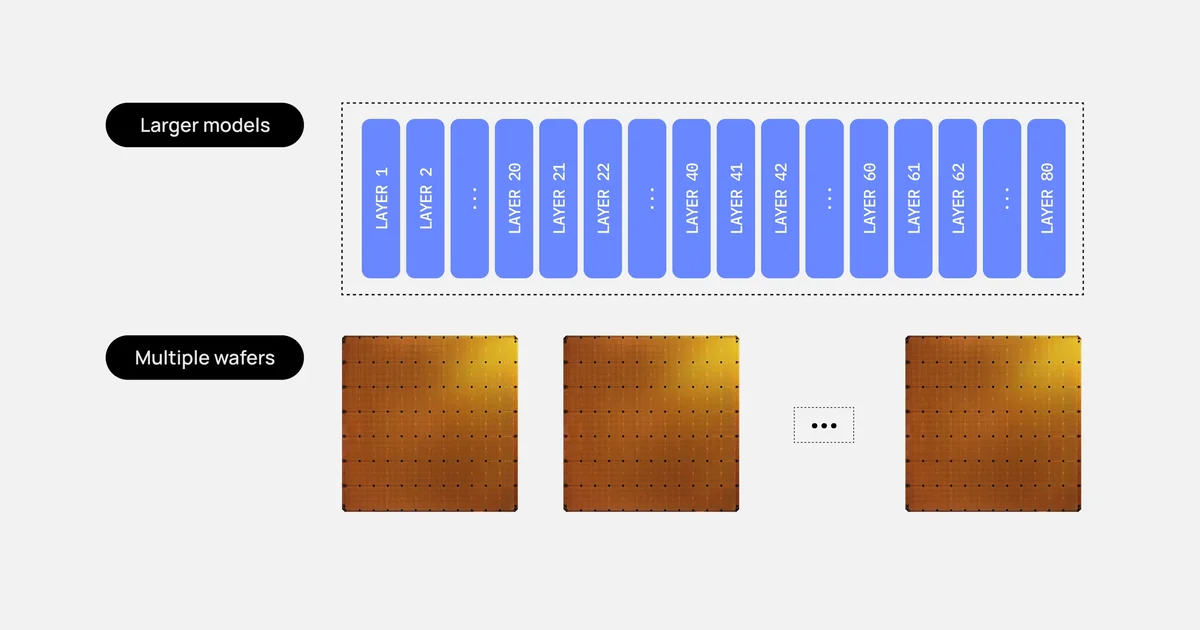
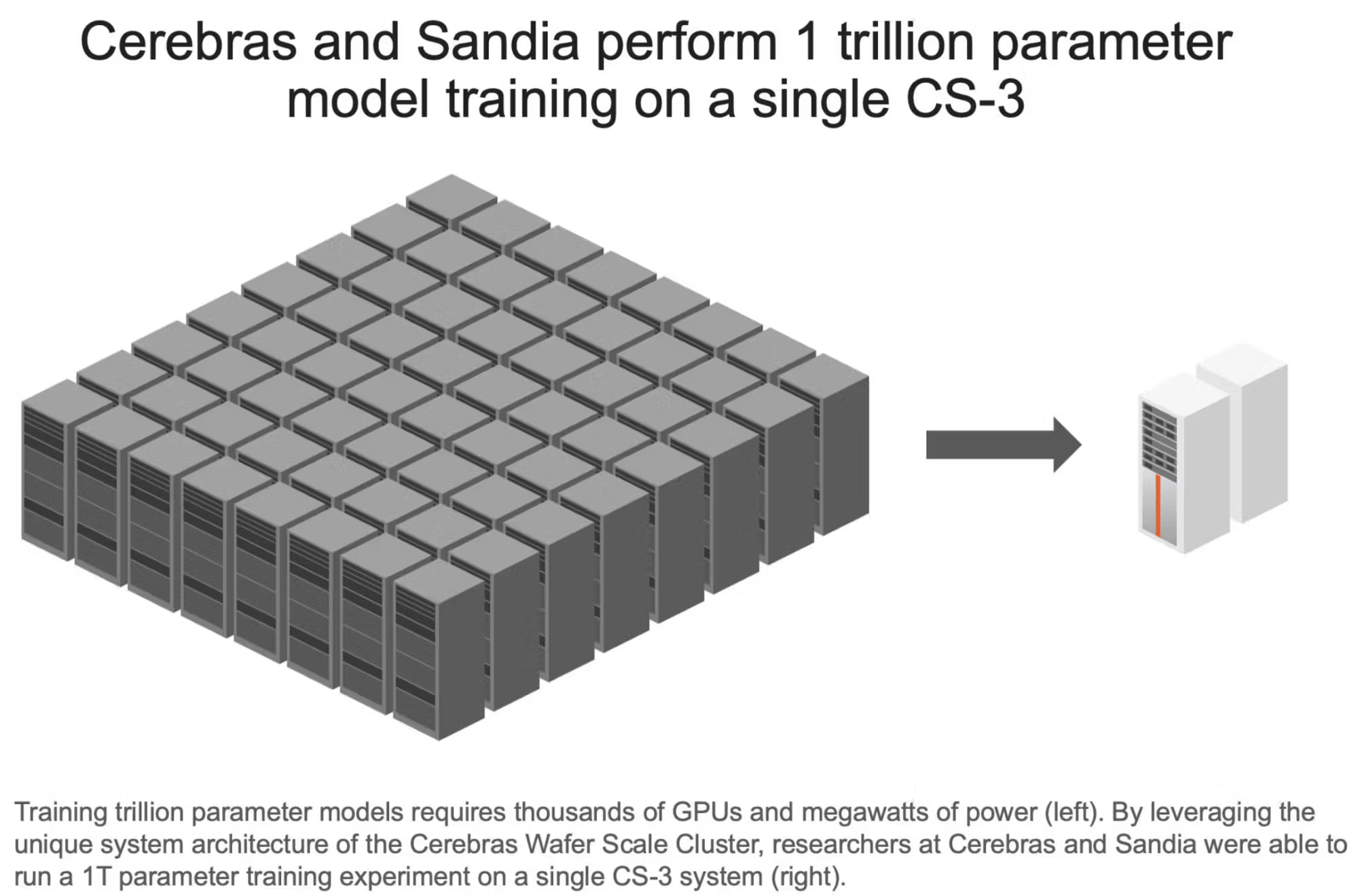
Traditional AI infrastructure is typically assembled from large numbers of graphics processing units (GPUs). Each accelerator often has limited memory, necessitating that a large model be divided across many chips. This process, known as model parallelism, introduces several technical challenges.
The first is communication. During inference—the process of generating an answer—the chips must continually exchange intermediate data. If communication between processors is slower than the computation itself, expensive hardware can spend much of its time waiting. The problem becomes more pronounced when users expect interactive responses rather than delayed batch results.
The second challenge is memory management. A model's parameters must be stored, and additional memory is needed for activations and the key-value cache used by many transformer-based systems. Increasing the length of a conversation or document can substantially increase this cache. A system designed for short prompts may therefore struggle with long-context applications such as legal discovery, scientific literature review, or software repository analysis.
The third challenge is operational complexity. A large GPU cluster requires networking, scheduling, cooling, power management, software libraries, and fault tolerance. Organizations must coordinate these components while maintaining predictable performance. The cost of running the system is determined not only by the number of chips but also by utilization, electricity, data-center capacity, and engineering labor.
03Cerebras’s Wafer-Scale Approach
Cerebras Systems addresses these constraints with a different hardware design. Its Wafer Scale Engine places a very large number of computing cores and a large amount of on-chip memory on a single silicon wafer. Instead of dividing computation across many conventional accelerator packages, the architecture is intended to keep more of the model and its intermediate data close to the processing elements.
This approach has two important consequences. It reduces the need to move data across external network links, and it allows the system to treat a wafer as a highly integrated computational unit. Cerebras’s CS-series systems are built around this concept and are designed for both training and inference workloads.
The objective is not simply to make a larger chip. It is to reduce the communication bottlenecks that appear when a model is distributed across hundreds or thousands of separate processors. High-bandwidth connections between cores can help the system perform the repeated calculations required by neural networks with less coordination overhead.
Cerebras has also emphasized software simplification. Developers still need to manage model architecture, data pipelines, and deployment policies, but the hardware can reduce some of the complexity associated with manually partitioning models across conventional accelerators. This can be particularly valuable for organizations that do not have large teams specializing in distributed systems.
04From Training Breakthroughs to Practical Inference
Training a trillion-parameter model and serving it to users are different challenges. Training involves processing enormous datasets repeatedly and adjusting model parameters. Inference involves generating responses quickly and reliably, often for many users at once.
Cerebras has positioned its systems for high-speed inference, including cloud-accessible services that allow developers to call supported models through application programming interfaces. The commercial importance of this capability is significant. A model may be highly capable, but if it takes too long to respond or costs too much per request, businesses will hesitate to integrate it into customer-facing products.
Fast inference can change how applications are designed. An assistant may be able to examine more documents before responding. A coding tool may provide suggestions with less interruption to a developer's workflow. A voice application may support more natural conversations because the delay between speech and response is reduced.
Latency is only one measure. Throughput—the number of tokens or requests processed over a given period—also affects economics. A customer-support platform serving millions of interactions needs consistent performance during peak demand. High throughput can allow a provider to serve more users with a smaller infrastructure footprint, although the final result depends on model size, prompt length, concurrency, and service pricing.
05What Trillion-Parameter Models Could Enable
Advanced Research and Scientific Discovery
Scientific work often requires connecting information across thousands of papers, experimental records, datasets, and simulations. A very large model could help researchers identify relationships that are difficult to detect through keyword searches alone. It might compare competing hypotheses, propose experiments, summarize evidence, or translate findings between fields.
For example, a materials-science team could ask an AI system to search the literature for compounds with particular electrical and thermal properties. The system could combine published results with internal laboratory data, identify gaps in the evidence, and recommend candidates for further testing. Human scientists would still need to validate the suggestions, but the model could reduce the time required to explore the possibility space.
In medicine, similar tools could assist with clinical documentation, biomedical research, and analysis of complex patient information. These applications require strict safeguards. A fluent answer is not proof of medical accuracy, and systems used in high-stakes environments must be tested for bias, hallucinations, privacy risks, and performance across different populations.
Engineering and Software Development
Large models can act as development partners capable of reading substantial codebases rather than isolated snippets. They may explain how services interact, identify likely failure points, generate tests, and help migrate older software to modern frameworks.
A trillion-parameter model could be especially useful when a problem requires combining multiple forms of context: source code, issue trackers, design documents, logs, security policies, and product requirements. Rather than merely completing a line of code, the system could help reason about the effects of a proposed architectural change.
Human review remains essential. Generated code can contain security vulnerabilities, licensing concerns, subtle logic errors, or inefficient implementations. The most productive approach is likely to treat the model as an exceptionally fast collaborator whose work is checked through tests, code review, and automated security analysis.
Business Intelligence and Decision Support
Organizations generate information across customer relationship systems, enterprise resource planning platforms, contracts, emails, and operational databases. A large model could provide a natural-language interface to this information, allowing executives and employees to ask questions without mastering every reporting tool.
An operations manager might ask why fulfillment times increased in a particular region. An AI system could compare inventory levels, staffing data, weather events, transportation delays, and customer orders. It could then present possible explanations and identify which additional data would confirm them.
These systems should not be treated as unquestionable decision-makers. Business data can be incomplete or inconsistent, and a model may confuse correlation with causation. Effective deployments will show supporting sources, preserve an audit trail, and give authorized employees control over consequential actions.
06Reshaping the Future of Work
The effect of trillion-parameter AI will not be limited to the elimination of individual tasks. It may reorganize entire workflows. Many jobs consist of gathering information, interpreting it, producing a draft, and coordinating with other people. AI can participate in each stage, allowing employees to spend more time on judgment, negotiation, creativity, and relationship-building.
In marketing, for instance, an AI system could analyze campaign performance, generate audience-specific concepts, draft content, and suggest experiments. Marketers would remain responsible for brand strategy, ethical boundaries, and final approval. In finance, an AI assistant could prepare variance analyses and scenario models, while analysts evaluate assumptions and communicate implications to decision-makers.
This transition will create demand for new skills. Employees will need to understand how to frame requests, verify outputs, protect confidential information, and identify when a model is operating outside its reliable range. Managers will need to redesign processes rather than simply add an AI tool to an existing workflow.
The most valuable workers may be those who combine domain expertise with the ability to supervise AI systems. A legal professional who understands both contract law and model limitations can use automation more safely than either a generalist user or an expert who ignores the technology's weaknesses.
07The Economics of Scale
Large-model deployment is expensive. Training requires substantial computational capacity, data-center infrastructure, electricity, cooling, and engineering time. Inference costs continue after training, because every user request consumes compute. Long prompts and extended conversations can increase those costs considerably.
Cerebras’s architecture seeks to improve the relationship between performance and infrastructure expense by reducing communication overhead and increasing useful utilization. Whether it produces a lower total cost depends on the workload and the comparison system. A small model running on modest hardware may remain more economical for routine tasks, while a large model may justify its expense when accuracy, context, or response speed has a direct commercial benefit.
This suggests a heterogeneous future. Companies may route simple requests to smaller specialized models and reserve larger systems for complex cases. A customer-service platform could use a compact model for classification, a retrieval system for factual lookups, and a larger model for unusual or multi-step problems. Intelligent routing can improve both cost and reliability.
08Challenges and Responsible Deployment
Scale introduces risks as well as capabilities. Large models can reproduce biases present in their training data, generate persuasive misinformation, expose sensitive information, or be manipulated through adversarial prompts. They may also make confident errors that are difficult for non-experts to recognize.
Security teams must consider prompt injection, unauthorized data access, model extraction, and the possibility that an AI agent could take an unsafe action through connected software. Access controls should follow the principle of least privilege. Systems should separate trusted instructions from untrusted documents and require confirmation before performing irreversible operations.
Privacy is another central concern. Businesses need clear policies governing which data may be sent to an external service, how long prompts are retained, and whether information is used for additional training. Sensitive workloads may require private deployments, encryption, redaction, or strict data-residency controls.
Energy consumption and environmental impact also deserve attention. More efficient hardware can reduce the resources required for a given computation, but efficiency gains may be offset if demand grows rapidly. Organizations should measure actual energy use, utilization, and emissions rather than assuming that a newer system is automatically sustainable.
09A Practical Adoption Framework
Companies considering large-model technology can begin with a focused use case rather than a broad transformation program.
Identify a measurable bottleneck. Look for workflows involving delays, repetitive analysis, or large volumes of unstructured information.
Establish a baseline. Record current costs, response times, error rates, and employee effort.
Select the appropriate model. The largest available system may not be the best choice. Compare quality, speed, privacy, and cost.
Use grounded data. Retrieval-augmented generation can connect model responses to approved internal sources and provide citations for review.
Keep humans involved where risk is high. Financial, medical, legal, employment, and safety-related decisions need appropriate oversight.
Test continuously. Evaluate accuracy, bias, robustness, latency, and behavior under unusual inputs.
Scale only after proving value. A successful pilot should demonstrate business improvement, not just impressive examples.
This disciplined approach also creates organizational learning. Teams discover which information is reliable, where processes are poorly documented, and which decisions genuinely require human expertise.
10The Road Ahead
Cerebras’s deployment of systems designed for very large models illustrates a broader shift in AI infrastructure. Progress is no longer determined solely by the number of parameters. It also depends on how efficiently computation moves through hardware, how quickly models respond, and how easily organizations can connect them to useful data and applications.
Trillion-parameter models will not replace every smaller system, nor will they remove the need for human judgment. Their importance lies in expanding the range of problems that AI can address, particularly problems requiring extensive context, sophisticated reasoning, and rapid interaction.
The organizations most likely to benefit will be those that combine advanced infrastructure with careful governance. They will treat AI as a capability to be engineered into workflows, measured against real outcomes, and continuously supervised. If Cerebras and similar companies can make massive models faster and more accessible, the result may be a new phase of computing—one in which intelligent assistance becomes a standard layer across research, industry, and everyday work.
For Cerebras Deploys Trillion-Parameter AI Models, Nonilion can be used as the practical AI-office example: a shared workspace where human teammates and AI agents keep discussion, decisions, and execution connected.
The reason Cerebras Deploys Trillion-Parameter AI Models keeps returning to Nonilion is simple: the topic becomes more useful when it turns into coordinated work, not just another article, chat, or dashboard.
11Why This Trend Matters for Nonilion
This trend matters to Nonilion because it points to a bigger change: teams are moving from simple calls toward persistent, AI-supported collaboration spaces. Nonilion can bridge live presence, meeting context, avatars, and follow-up work so the trend becomes a usable workflow instead of a headline.
12Shareable Extracts
The trend is not just "The Dawn of Hyper-Intelligence: How Cerebras Deploys Trillion-Parameter AI Models and Reshapes the Future of Work" - it is a signal that team coordination is becoming the next competitive edge.
Hot take: the teams that win from this shift will not be the ones with more meetings; they will be the ones with clearer shared context after every meeting.
If the dawn of hyper-intelligence: how cerebras deploys trillion-parameter ai models and reshapes the future of work keeps moving this fast, remote teams need a workspace where conversation, presence, and follow-up stay connected.
This scale of computation and data processing capability could potentially unlock new approaches to intelligence, aiming to move beyond basic task automation towards more sophisticated reasoning and complex problem-solving.
For businesses navigating the complexities of the modern world, understanding the implications of such advanced AI can be valuable for strategic planning and operational evolution.
13Social Hooks
Everyone is talking about The Dawn of Hyper-Intelligence: How Cerebras Deploys Trillion-Parameter AI Models and Reshapes the Future of Work. The overlooked part is what happens to team workflows after the headline fades.
The uncomfortable question behind The Dawn of Hyper-Intelligence: How Cerebras Deploys Trillion-Parameter AI Models and Reshapes the Future of Work: are teams adapting their collaboration systems fast enough?
This is not a meeting trend. It is a coordination trend, and products like Nonilion sit right in the middle of that shift.
14Sources and Author
Sources
No direct external source URLs were available for this run.
Author
This article on Cerebras Deploys Trillion-Parameter AI Models was generated by the Nonilion AI blog workflow using web research inputs and AI-assisted synthesis.