



Developer Productivity
openclaw: What Developers Need to Know
OpenClaw and the Evolution of AI: From Personal Productivity to Collaborative Intelligence The landscape of artificial intelligence is rapidly evolving, moving beyond simple tools
01OpenClaw and the Evolution of AI: From Personal Productivity to Collaborative Intelligence
The landscape of artificial intelligence is rapidly evolving, moving beyond simple tools to become integral partners in our daily and professional lives. OpenClaw is a project that highlights the potential for accessible, autonomous AI. As we explore OpenClaw, we will also consider its potential implications for AI's role in the workplace, particularly in the context of collaborative AI.
I. Introduction: Exploring the Actionable Personal AI Agent
The concept of an AI personal assistant that performs tasks has long been a goal. OpenClaw offers a self-hosted, open-source AI agent designed to automate a range of personal tasks directly from familiar chat interfaces. It represents a stride in making AI agents practical and privacy-respecting for individuals.
Want your team to run this workflow with AI-native execution?
However, as organizations increasingly look to leverage AI, the conversation extends beyond personal productivity. How do the principles behind OpenClaw relate to scaling AI for a team, a department, or an entire enterprise? This article will explore OpenClaw's approach, its implications for individual autonomy and efficiency, and how its vision of an actionable AI agent relates to the concept of collaborative AI agents within a unified, shared workspace, such as those offered by platforms like Nonilion.
II. What is OpenClaw? Exploring the Personal AI Agent
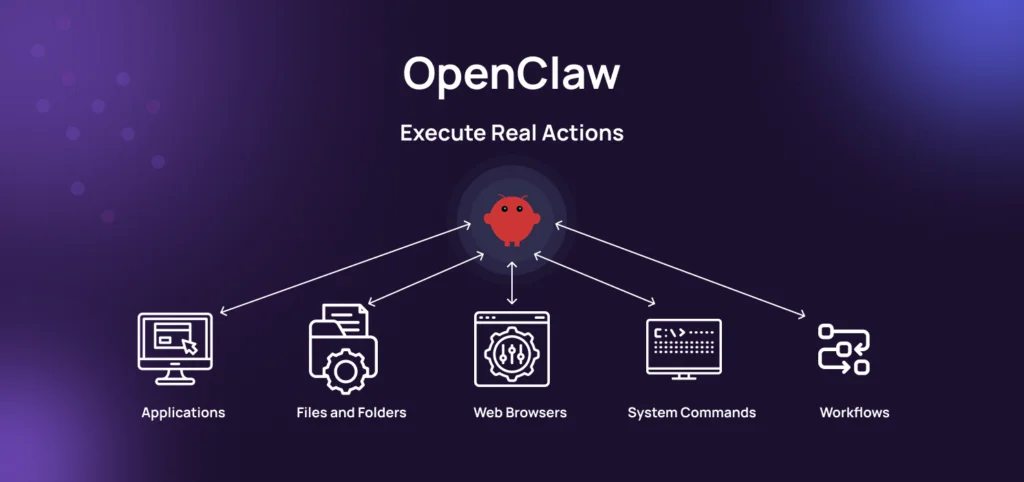
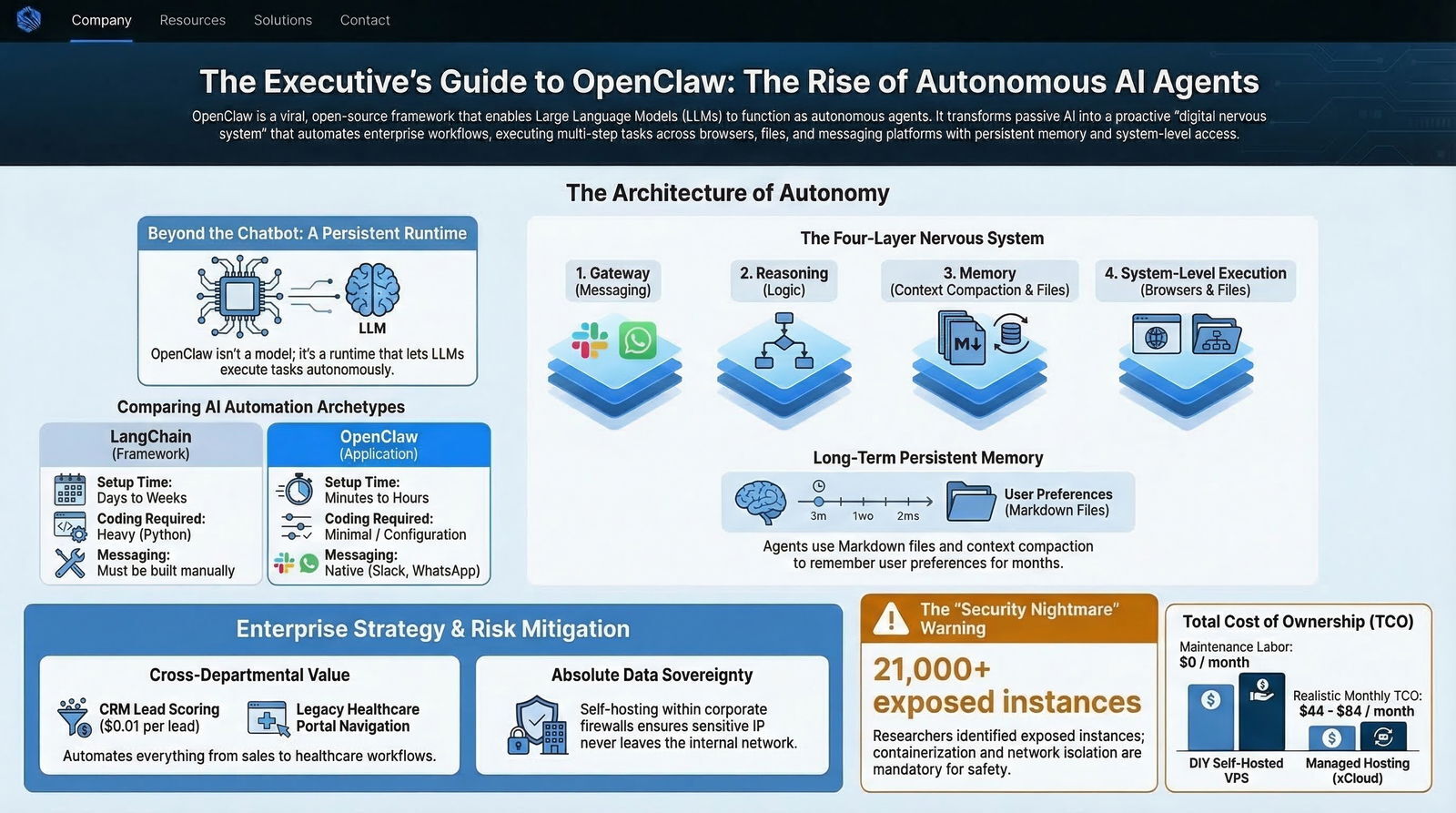
OpenClaw is an autonomous artificial intelligence agent designed for personal use, emphasizing self-hosting and integration with existing messaging platforms. It's built on the premise that AI should be a proactive, task-executing entity rather than just an information retriever, as highlighted by its tagline, "The AI that actually does things."
A. Core Functionality and Philosophy
Action-Oriented AI: OpenClaw is engineered to perform concrete actions. This includes clearing inboxes, sending emails, managing calendars, and checking users in for flights. Its "doing things" mantra reflects a focus on active execution rather than passive assistance, often accessible from platforms like WhatsApp or Telegram.
Self-Hosted and Open-Source: OpenClaw is open-source and can be run on personal devices (macOS, Linux, Windows). This approach can offer users increased control over their data, privacy, and customization options, which may appeal to those prioritizing alternatives to cloud-based solutions. The project's GitHub repository provides the resources for this self-hosting.
Access via Chat Interfaces: OpenClaw integrates with popular chat applications like WhatsApp and Telegram. This is intended to allow users to interact with their AI assistant in a natural, conversational manner, potentially reducing the learning curve and improving accessibility.
Skill Workshop and Reusability: The platform's emphasis on turning agent work into reusable skills hints at a modular, extensible architecture. This is designed to allow users to tailor and expand their agent's capabilities, potentially supporting a community-driven development model.
B. The "Lobster Way" - A Metaphor for Autonomy
The project's branding, often referencing "the lobster way" (as seen in its community discussions), subtly underscores its philosophy: an autonomous, self-sufficient entity capable of navigating its environment and performing complex tasks. This metaphor resonates with the desire for an AI that operates independently, requiring minimal oversight once configured.
III. Why Personal AI Agents are Considered: Autonomy, Privacy, and Efficiency
The emergence of personal AI agents like OpenClaw addresses several needs in our increasingly digital lives, particularly for individuals seeking enhanced control and productivity.
A. Potential for Empowering Individual Productivity and Focus
Task Offloading: By automating routine, time-consuming tasks (email triage, scheduling), personal AI agents can free up significant mental bandwidth, allowing individuals to concentrate on higher-value, creative, or strategic work.
Proactive Assistance: Rather than waiting for commands, these agents can aim to anticipate needs and execute tasks autonomously, transforming reactive interaction into proactive support.
Seamless Integration into Daily Routines: Operating within familiar chat apps can mean the AI assistant becomes an unobtrusive part of existing workflows, potentially reducing friction and adoption barriers.
B. Considering Privacy and Data Control
Self-Hosting for Data Sovereignty: In an era of heightened data privacy concerns, the ability to run an AI agent on one's own infrastructure can be a powerful differentiator. It can mean personal data remains local, under the user's direct control, alleviating worries about third-party access or misuse, a core tenet of the OpenClaw philosophy.
Transparency and Trust: Open-source development can foster transparency, allowing users and developers to inspect the code, understand its workings, and contribute to its security. This can build a foundation of trust that proprietary, black-box AI solutions often struggle to achieve.
C. Potential for Customization and Adaptability
Tailored to Individual Needs: The open-source nature and skill workshop approach can allow users to customize their AI agent to their specific preferences, workflows, and unique requirements, making it truly "personal."
Future-Proofing through Community: A vibrant open-source community can ensure continuous development, security updates, and the evolution of new features and skills, making the agent adaptable to future challenges and opportunities.
IV. The Leap from Personal Productivity to Collaborative Intelligence: What OpenClaw Means for AI Offices
OpenClaw demonstrates the power of an individual, actionable AI agent. However, as we look to scale AI's impact beyond personal productivity, a critical question arises: How do we transition from empowering individuals to enhancing collective intelligence within a team or organizational context? This is where the concept of the "AI Office" comes into sharp focus.
While OpenClaw excels at automating tasks for one person, its design inherently limits its capacity for complex, multi-stakeholder collaboration. It operates within individual chat interfaces, lacking a unified environment for persistent team knowledge, shared project context, or orchestrated cross-agent collaboration. Imagine a team trying to coordinate a complex project where each member has their own personal AI, but these AIs cannot communicate, share context, or collectively work towards a common goal in a structured way. The efficiency gains could quickly be offset by the fragmentation of information and effort.
This highlights a fundamental difference between personal AI agents and the needs of a collaborative AI office. An AI office requires more than just individual task automation; it demands a system where:
- Multiple AI Agents Coexist and Collaborate: Different agents, each perhaps specialized in a particular domain (e.g., meeting summarization, market research, code generation), need to work together seamlessly.
- Shared Context and Memory are Paramount: Agents and humans need access to a common, persistent knowledge base and understanding of ongoing projects, decisions, and discussions.
- Orchestration and Workflow Automation Span Teams: AI should facilitate complex workflows that involve multiple human and AI participants across different functions.
This is precisely the challenge that platforms like Nonilion aim to address. Nonilion is designed as a collaborative AI office, providing a unified virtual workspace where humans and multiple, specialized AI agents work together seamlessly. While OpenClaw empowers an individual to "do things," Nonilion orchestrates a team of AI agents (and humans) to achieve collective, larger-scale objectives, moving beyond individual task automation to foster a new era of collective intelligence. It's about shifting from a single AI assistant to an entire AI team operating in concert within a shared environment.
V. How Collaborative AI Agents Can Transform Team Workflows
The transition from personal AI agents to collaborative, multi-agent systems within a shared workspace can unlock potential for transforming team workflows.
A. Orchestrating Multi-Agent Systems for Complex Projects
Specialized Roles: In a collaborative AI office, different AI agents can be assigned specialized roles, mirroring human teams. One agent might be responsible for data analysis, another for drafting communications, and a third for project timeline management.
Inter-Agent Communication and Coordination: Unlike disparate personal agents, collaborative AI agents can be designed to communicate with each other, share information, and coordinate actions to achieve a common goal. This allows for complex workflows that would be challenging for a single agent or a collection of isolated ones.
Dynamic Task Allocation: AI offices can aim to dynamically allocate tasks to the most suitable human or AI agent, potentially optimizing resource utilization and accelerating project completion.
B. Enhancing Shared Context and Knowledge Management
Persistent Workspace Memory: A key consideration for personal chat-based agents is the ephemeral nature of their interactions. In a collaborative AI office, all interactions, decisions, and generated insights can be captured and maintained within a persistent workspace. This can create a living, evolving knowledge base accessible to all team members, human and AI.
Contextual Understanding: AI agents operating within a shared workspace can be designed to have a deeper, more consistent understanding of ongoing projects, team goals, and historical data. This can allow them to provide more relevant and accurate assistance, potentially reducing the need for constant re-briefing.
Automated Documentation and Summarization: Collaborative AI agents can be configured to automatically document discussions, summarize meetings, and synthesize information from various sources, aiming to ensure that team members are up-to-date and have access to critical information without extensive manual effort.
C. Streamlining Cross-Functional Collaboration
Breaking Down Silos: AI agents can act as intelligent bridges between different departments or functions, translating information, coordinating tasks, and aiming to ensure alignment across diverse teams.
Automated Follow-ups and Action Tracking: Collaborative AI can monitor project progress, identify potential bottlenecks, and proactively initiate follow-ups with relevant team members (human or AI), aiming to ensure accountability and keep projects on track.
Nonilion embodies this transformation by providing a persistent environment where specialized AI agents can maintain context across projects, assist with meeting follow-ups, and execute async tasks. This aims to ensure that team coordination is aligned, and the collective intelligence of both humans and AI agents is leveraged to its potential, moving beyond individual task automation to collective, orchestrated action.
VI. When to Scale: From Individual Automation to Organizational AI Strategy
The decision to scale from individual AI tools to an organizational AI strategy is a critical inflection point for any business looking to harness the full power of artificial intelligence. While personal AI agents like OpenClaw offer immediate, tangible benefits for individual productivity, there comes a time when their inherent limitations for collaborative, multi-stakeholder endeavors may become apparent.
A. Recognizing the Limitations of Disparate Personal AI
Information Silos: When every individual uses their own personal AI assistant, valuable insights, automated actions, and generated content may remain fragmented, trapped within individual chat logs or local machines. This can create new information silos, potentially hindering shared understanding and collective progress.
Lack of Centralized Governance and Oversight: For organizations, maintaining compliance, security, and ethical AI use across a multitude of personal agents can be challenging. A centralized strategy may be essential for responsible AI deployment.
Inefficient Resource Duplication: If multiple individuals are using their personal AIs to solve similar problems or gather similar information, it can lead to duplicated effort and inefficient use of AI capabilities.
Scalability Challenges: Personal AI solutions are not typically designed to scale seamlessly across an entire organization, integrate with enterprise-level systems, or manage complex, interdependent workflows.
B. The Need for a Unified AI Office Environment
The moment an organization realizes that its challenges extend beyond individual task automation to include complex project coordination, cross-functional collaboration, and the need for a shared, evolving knowledge base, is when a unified AI office strategy may become imperative. This shift can be driven by the desire to:
- Maximize Collective Intelligence: Leverage AI to enhance the intelligence of the entire team, not just individual members.
- Ensure Data Cohesion and Accessibility: Create a single source of truth where all AI-generated insights and human contributions reside and are accessible.
- Implement Consistent AI Policies: Govern AI usage, ensure ethical guidelines, and maintain security standards across all AI interactions.
- Foster True Human-AI Collaboration: Create an environment where humans and AI agents can truly co-create, co-manage, and co-execute tasks in a structured, transparent manner.
VII. Where the Future of Work May Reside: The Human-AI Collaborative Office
The journey from individual AI assistants to collaborative AI agents within a unified workspace may define the future of work. This future is not about replacing humans with AI, but about augmenting human capabilities and fostering collaboration between people and intelligent machines.
A. Envisioning the Human-AI Co-working Paradigm
In a human-AI collaborative office, AI agents can be considered integral team members. They can participate in discussions, contribute data-driven insights, automate routine processes, and proactively identify opportunities or risks. This paradigm can shift the focus from humans managing AI to humans and AI co-managing projects and workflows.
Intelligent Augmentation: AI agents can handle the repetitive, data-intensive, or time-consuming aspects of work, allowing humans to focus on creativity, strategic thinking, emotional intelligence, and complex problem-solving that still requires human intuition.
Seamless Workflow Orchestration: Complex, multi-step workflows involving multiple human and AI touchpoints can be automated and orchestrated by the AI office. This can aim to ensure consistency, reduce errors, and accelerate project timelines.
Democratization of Expertise: Specialized AI agents can bring expert knowledge to team members, potentially democratizing access to information and capabilities.
B. The Role of a Unified Platform in Fostering Human-AI Co-working
A unified platform is a cornerstone of this future. It provides the necessary infrastructure for:
-
Shared Context and Memory: A common operational picture for all human and AI participants, aiming to ensure everyone is on the same page.
-
Interoperability and Integration: Seamless connection between various AI agents, human tools, and enterprise systems.
-
Governance and Control: The ability to manage, monitor, and adapt the AI ecosystem to organizational needs and ethical standards.
-
Dynamic Adaptation: The platform should be able to learn from interactions, adapt to changing priorities, and evolve its capabilities over time.
Nonilion stands as a practical example of this future, providing the framework for human + AI co-working. It moves beyond the concept of a personal AI assistant to offer a comprehensive AI office where AI agents can become extensions of the team, handling complex workflows, facilitating efficient async execution, and contributing to collective intelligence within a single, shared workspace. This collaborative environment is where the potential of AI in the workplace can be realized, transforming how teams operate and innovate.
VIII. Conclusion: Orchestrating the Next Generation of AI-Powered Work
OpenClaw represents a step forward in personal AI, demonstrating the potential impact of actionable, self-hosted agents on individual productivity and privacy. Its innovation highlights a broader trend: the increasing sophistication and utility of AI in our daily lives.
However, the vision of AI's ultimate impact extends beyond the individual. The future of work may lie in the intelligent collaboration between humans and AI, orchestrated within a shared, dynamic environment. As organizations seek to harness AI for complex projects, cross-functional coordination, and collective problem-solving, the need for a collaborative AI office may become paramount. Platforms like this platform are at the forefront of this evolution, building the virtual workspaces where specialized AI agents and human teams can seamlessly co-exist, share context, and collectively drive innovation. The journey from personal AI assistant to a fully integrated, collaborative AI office is not just an upgrade in technology; it's a fundamental shift in how we define and execute work in the AI era.
02Why This Trend Matters for Nonilion
This trend matters to Nonilion because it points to a bigger change: teams are moving from simple calls toward persistent, AI-supported collaboration spaces. Nonilion can bridge live presence, meeting context, avatars, and follow-up work so the trend becomes a usable workflow instead of a headline.
03Shareable Extracts
- The trend is not just "openclaw: What Developers Need to Know" - it is a signal that team coordination is becoming the next competitive edge.
- Hot take: the teams that win from this shift will not be the ones with more meetings; they will be the ones with clearer shared context after every meeting.
- If openclaw: what developers need to know keeps moving this fast, remote teams need a workspace where conversation, presence, and follow-up stay connected.
- OpenClaw is a project that highlights the potential for accessible, autonomous AI.
- As we explore OpenClaw, we will also consider its potential implications for AI's role in the workplace, particularly in the context of collaborative AI.
04Social Hooks
- Everyone is talking about openclaw: What Developers Need to Know. The overlooked part is what happens to team workflows after the headline fades.
- The uncomfortable question behind openclaw: What Developers Need to Know: are teams adapting their collaboration systems fast enough?
- This is not a meeting trend. It is a coordination trend, and products like Nonilion sit right in the middle of that shift.
05Sources and Author
Sources
-
OpenClaw — Personal AI Assistant openclaw.ai
-
OpenClaw — Personal AI Assistant github.com/openclaw/openclaw
-
OpenClaw en.wikipedia.org/wiki/OpenClaw
-
r/openclaw www.reddit.com/r/openclaw/
Author
This article on openclaw was generated by the Nonilion AI blog workflow using web research inputs and AI-assisted synthesis.