Home/Blog/AI, Lean, and the Future of Formal Verification, with Lean Creator Leo de Moura
human + AI workflows
AI, Lean, and the Future of Formal Verification, with Lean Creator Leo de Moura
AI, Lean, and the Future of Formal Verification, with Lean Creator Leo de Moura The quest for certainty in an increasingly complex, AI-driven world is more critical than ever. As a
14 MIN READ
01 Nov 2026
human + AI workflows
AI, Lean, and the Future of Formal Verification, with Lean Creator Leo de Moura
The quest for certainty in an increasingly complex, AI-driven world is more critical than ever. As artificial intelligence systems become integral to software development and mathematical exploration, the need for rigorous verification methods grows. At the forefront of this evolution is Lean, a powerful proof assistant and programming language, championed by its creator, Leonardo de Moura. This discussion delves into how Lean, coupled with AI, is reshaping formal verification, fostering unprecedented collaboration, and laying the groundwork for a future where trust is embedded through verifiable certainty, even within advanced AI offices like Nonilion.
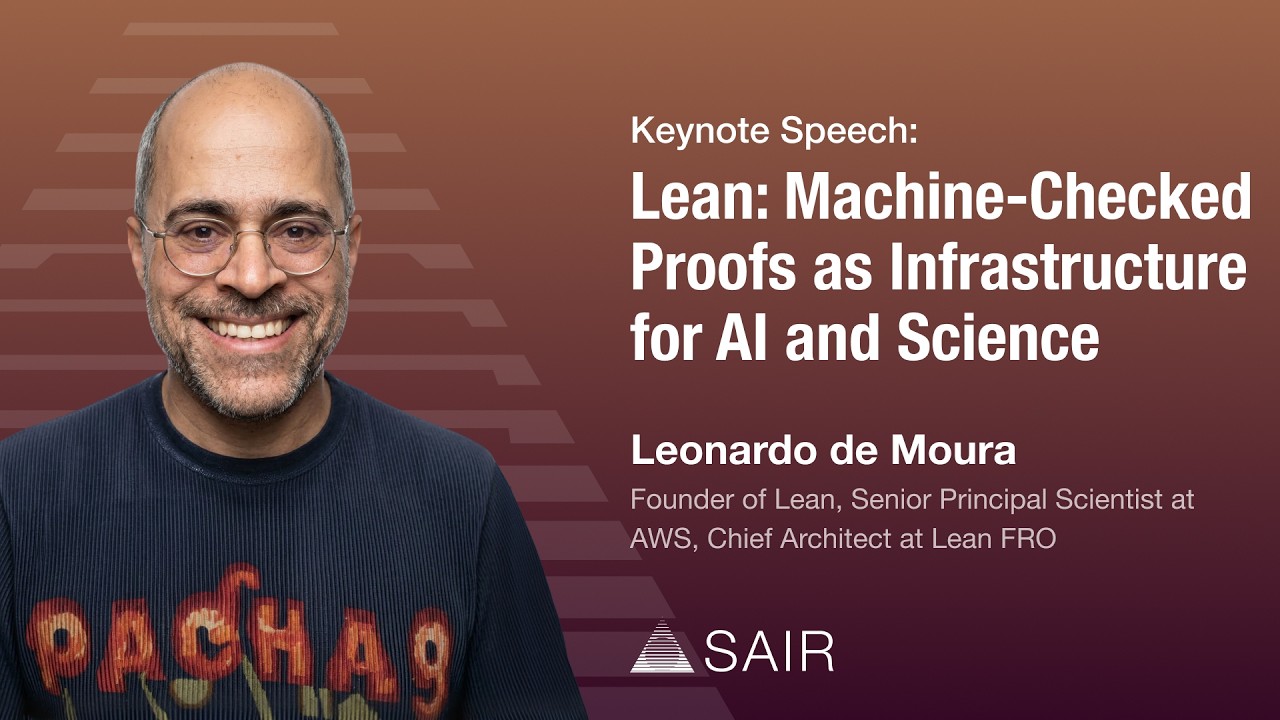
Lean, conceived by Leonardo de Moura, began its journey in 2013 as a direct response to fundamental limitations in existing systems [6]. De Moura, also known for co-creating the Z3 SMT solver, developed Lean as a tool that transcends traditional boundaries [3, 7]. It functions both as a sophisticated proof assistant and a robust programming language, uniquely utilizing the same syntax for writing proofs and developing code [1, 3, 5]. This inherent duality is a cornerstone of its power, bridging what were once disparate domains.
Leonardo de Moura envisions Lean 4, the latest iteration, as a pivotal tool for comprehensive software verification [1, 5]. This ambition speaks to a future where the integrity of software is not merely assumed but formally proven. The ability of Lean to serve these dual roles means that developers and mathematicians can leverage a unified environment to build and verify systems with unparalleled precision. This integration is vital in an era where software underpins virtually every aspect of our lives, from critical infrastructure to sophisticated AI agents.
02Formal Verification: AI's Role in a New Era of Certainty
Formal verification represents a rigorous, hype-free deep dive into ensuring the correctness of systems and proofs [7]. Historically, the process of writing and maintaining formal proofs was an arduous undertaking, often demanding ten times the effort required to write the code itself [3]. This significant overhead limited its widespread adoption, confining it primarily to highly critical systems where the cost was justified.
However, the advent of AI is dramatically altering this landscape. Artificial intelligence is now significantly lowering the cost barrier associated with formal verification, making it more accessible and practical for a broader range of applications [3]. This transformation is evidenced by remarkable achievements:
A colleague, leveraging AI, formalized and verified the zlib compression library in just one week [3]. This task, once considered monumental, demonstrates the profound efficiency gains AI brings to the verification process.
Another testament to AI's impact is the completion of a million-line formal proof for the unit distance conjecture in approximately two weeks [3]. Such a feat underscores the scalability and speed that AI introduces to complex mathematical formalization.
These examples highlight a paradigm shift: AI is not merely assisting but fundamentally reshaping the economics and feasibility of formal verification. This enables a future where the
formal correctness of software and mathematics can become a practical standard rather than an exceptional luxury.
03Proof-Producing AI: Why Trust Still Matters
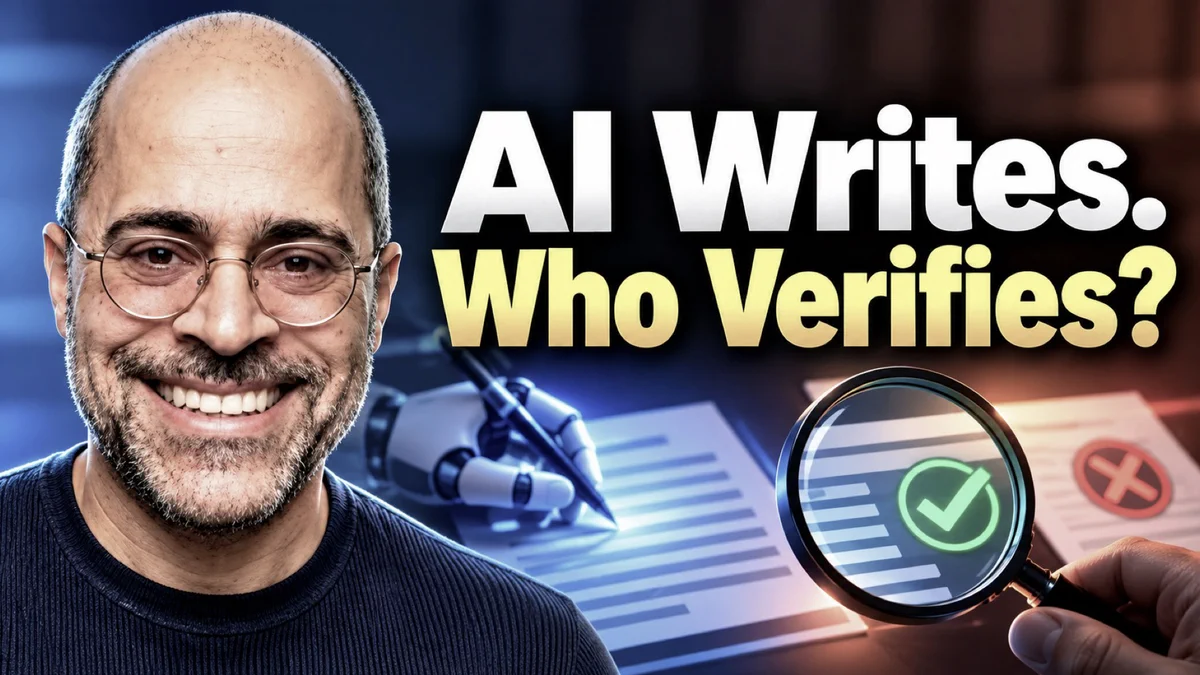
The relationship between AI and formal verification is not simply about asking a model to produce an answer. Large language models can generate plausible-looking code and arguments, but plausibility is not proof. They may omit assumptions, mishandle edge cases, or confidently state conclusions that do not follow from their premises.
Lean changes the role AI plays in this process. An AI system can propose a theorem, write a proof, search a library for relevant lemmas, or generate implementation code. Lean’s kernel then checks whether the resulting term is valid according to the system’s rules. If the proof does not type-check, it is rejected. If it does, the result comes with a precise, machine-checkable certificate.
This distinction is central to trustworthy AI. The model does not need to be treated as an unquestionable authority. It can function as a fast and creative assistant whose output is evaluated by a comparatively small and auditable trusted core. In this arrangement, AI supplies exploration and automation, while the proof assistant supplies a final standard of acceptance.
The approach resembles compilation and testing, but with a stronger guarantee in the areas covered by the specification. A test can show that a program works for selected inputs. A formal proof can establish that a property holds for every input satisfying stated conditions. The quality of the guarantee depends on the specification, but once the specification is correct and sufficiently complete, the proof offers a level of assurance that ordinary testing cannot provide on its own.
04Lean as a Common Language for Mathematics and Software
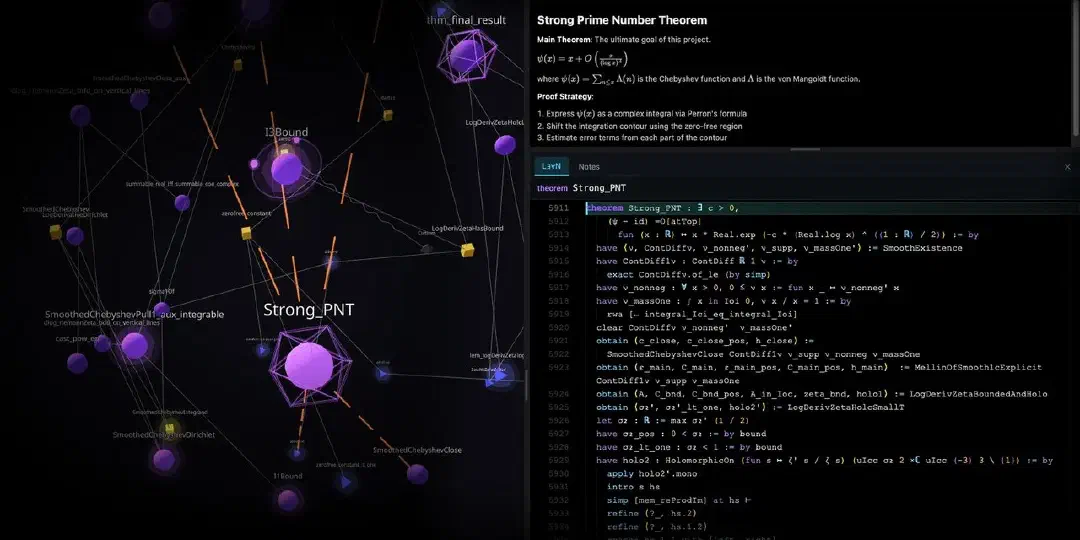
Lean’s importance also comes from its ability to connect abstract mathematics with executable programs. In traditional workflows, a mathematical theorem might be written in one language, an algorithm implemented in another, and the connection between them documented informally. Lean can represent the definitions, theorems, algorithms, and correctness arguments within a single environment.
For example, a developer might define a data structure, specify an operation on it, and prove properties such as:
the operation preserves a required invariant;
an algorithm always terminates;
an optimized implementation returns the same result as a simpler reference implementation;
two components agree on the format and meaning of exchanged data.
These properties are not limited to textbook mathematics. They are directly relevant to compilers, cryptographic protocols, distributed systems, financial software, and safety-critical infrastructure. A verified sorting algorithm, for instance, should not merely return a list; it should be possible to establish that the output is ordered and contains exactly the elements of the input. A verified compiler should preserve the meaning of the programs it transforms. A verified cryptographic implementation should satisfy the mathematical relationships on which its security arguments depend.
Lean 4 strengthens this vision by providing facilities for general-purpose programming, metaprogramming, and performance-oriented development. Its users can write tactics that automate proof steps, create domain-specific tools, and build applications whose correctness arguments remain close to their implementations. The result is not a separate “proof after coding” stage, but a development process in which definitions and guarantees evolve together.
05The Mathematics Library Effect
Formal verification becomes more useful as reusable libraries grow. A theorem proved once can serve as a building block for many later results, provided its statement and assumptions are clear. This creates a compounding effect: each formalized definition, algebraic structure, and supporting lemma can reduce the effort required for future work.
The mathlib ecosystem illustrates this collaborative model. Contributors formalize results across areas such as algebra, analysis, number theory, combinatorics, topology, and probability. They also develop conventions for naming, organizing, and documenting mathematical material. Such standardization matters because AI systems, like human users, benefit from consistent interfaces and well-structured knowledge.
A mature library does more than store finished theorems. It exposes patterns of reasoning. An automated system can learn that a goal is likely to be solved by applying a particular theorem, rewriting with an established identity, or invoking a tactic designed for a certain class of expressions. Retrieval, search, and proof generation therefore reinforce one another: better libraries make AI assistance more effective, while AI can help identify missing lemmas and suggest formalizations.
This is one reason formal mathematics is often described as an ecosystem rather than a collection of isolated proofs. The value lies not only in individual results but in the network of definitions, abstractions, automation, and verified dependencies that makes new results easier to construct.
06What AI Can and Cannot Automate
AI-assisted proving is advancing quickly, but it is important to distinguish several different tasks. Generating a short proof from a clear goal is one challenge. Translating informal mathematics into precise definitions is another. Choosing the right abstraction, identifying hidden assumptions, and deciding what should be proved may be more difficult still.
An informal statement can conceal crucial ambiguities. Consider the claim that a function is “continuous” or that an algorithm is “efficient.” In a formal setting, the relevant domain, topology, resource model, and quantifiers must be specified. A proof assistant will not silently fill in these details merely because a human reader finds the intended meaning obvious. This apparent friction is also a benefit: formalization exposes gaps that prose can leave unnoticed.
AI can help resolve these difficulties by proposing definitions, generating examples and counterexamples, and comparing alternative formulations. It can also suggest intermediate lemmas that make a difficult proof tractable. Yet human judgment remains necessary to determine whether the formal statement captures the intended concept. A flawlessly checked proof of the wrong theorem is still the wrong result.
There is also a practical distinction between proving properties of a program and proving that the properties themselves are sufficient. A system may formally guarantee memory safety while leaving confidentiality, availability, or social impact outside the specification. Formal methods provide dependable answers to formalized questions; they do not automatically decide which questions matter.
07Verification in AI Systems
The same ideas apply to AI systems themselves. Machine-learning models are often difficult to verify in the conventional sense because their behavior depends on data, optimization procedures, and high-dimensional parameters. Nevertheless, formal methods can address specific components and guarantees.
They can be used to verify parts of an AI pipeline, check the behavior of safety filters, prove properties of data transformations, and establish bounds under defined perturbations. Formal specifications may also govern the tools used by an AI agent. An agent that edits code, moves files, or invokes external services can operate within a verified interface that restricts which actions are permitted and records the conditions under which they are valid.
For theorem-proving systems, the objective is especially direct: an AI-generated argument must result in a proof object accepted by Lean. This does not eliminate every risk, but it narrows the trust boundary. Instead of trusting the model’s natural-language explanation, users can inspect the formal statement, its dependencies, and the kernel’s verification result.
In an enterprise environment, this could support a layered assurance process. AI might generate a proposed change, automated tools could compile and prove local properties, and human reviewers could assess architecture, specifications, and broader risks. The formal artifacts would become part of the development record, alongside source code, tests, and design documentation.
08The Human Side of Formalization
Formal verification is sometimes presented as an attempt to remove people from reasoning. In practice, it changes where human effort is spent. Engineers and mathematicians may spend less time carrying out routine deductions and more time selecting useful abstractions, designing specifications, and interpreting results.
This shift requires new skills. A productive Lean user needs familiarity with the relevant domain, the ability to decompose problems into formal statements, and an understanding of how libraries and tactics work. AI can lower the entry barrier, but it does not make conceptual understanding irrelevant. Users still need to recognize when an automated proof is solving the intended problem and when an overly weak assumption has made the result meaningless.
Education is therefore likely to become an important part of Lean’s future. Students can receive immediate feedback when a definition is ambiguous or a proof step is invalid. They can experiment with conjectures and use counterexamples to refine their understanding. Rather than treating proof assistants only as advanced research tools, institutions may increasingly use them to teach precise mathematical reasoning and software design.
09A More Verifiable Future
The long-term promise of Lean and AI is not that every line of code or every mathematical idea will instantly become formalized. The more realistic and more valuable prospect is a gradual expansion of the domain in which strong guarantees are affordable.
As automated proof search improves, formal libraries become richer and development tools become easier to use, verification can move earlier in the lifecycle of a project. Specifications may be checked before implementation is complete. AI-generated code may arrive with proofs of selected invariants rather than unsupported assertions. Changes to critical components may trigger not only tests but also incremental proof checks.
This future will still involve trade-offs. Formalization takes time, specifications can be incomplete, and some properties are difficult to express or prove. But the economics are changing. When AI can help produce and maintain proofs at a fraction of their historical cost, organizations can apply formal methods to systems that previously would have been considered too large or too ordinary to verify.
Leo de Moura’s work on Lean represents a foundation for this transition: a system in which programming, mathematics, and verification are connected by a common formal language. AI adds a new layer of leverage, accelerating search and reducing repetitive effort without replacing the need for precise definitions and accountable reasoning. Together, they point toward software and mathematical workflows in which trust is not inferred from confidence or reputation alone, but supported by artifacts that machines and people can inspect.
The central idea is straightforward but consequential: intelligent systems may generate rapidly, yet reliable systems must also be able to show why their results should be accepted. Lean offers one of the clearest environments for building that bridge between discovery and certainty.
For AI, Lean, and the Future of Formal Verification, with Lean Creator Leo de Moura, Nonilion can be used as the practical AI-office example: a shared workspace where human teammates and AI agents keep discussion, decisions, and execution connected.
10Why This Trend Matters for Nonilion
This trend matters to Nonilion because it points to a bigger change: teams are moving from simple calls toward persistent, AI-supported collaboration spaces. Nonilion can bridge live presence, meeting context, avatars, and follow-up work so the trend becomes a usable workflow instead of a headline.
11Shareable Extracts
The trend is not just "AI, Lean, and the Future of Formal Verification, with Lean Creator Leo de Moura" - it is a signal that team coordination is becoming the next competitive edge.
Hot take: the teams that win from this shift will not be the ones with more meetings; they will be the ones with clearer shared context after every meeting.
If ai, lean, and the future of formal verification, with lean creator leo de moura keeps moving this fast, remote teams need a workspace where conversation, presence, and follow-up stay connected.
AI, Lean, and the Future of Formal Verification, with Lean Creator Leo de Moura The quest for certainty in an increasingly complex, AI-driven world is more critical than ever.
As artificial intelligence systems become integral to software development and mathematical exploration, the need for rigorous verification methods grows.
12Social Hooks
Everyone is talking about AI, Lean, and the Future of Formal Verification, with Lean Creator Leo de Moura. The overlooked part is what happens to team workflows after the headline fades.
The uncomfortable question behind AI, Lean, and the Future of Formal Verification, with Lean Creator Leo de Moura: are teams adapting their collaboration systems fast enough?
This is not a meeting trend. It is a coordination trend, and products like Nonilion sit right in the middle of that shift.
AI, Lean, and the Future of Formal Verification, with ...
www.google.com/goto
Author
This article on AI, Lean, and the Future of Formal Verification, with Lean Creator Leo de Moura was generated by the Nonilion AI blog workflow using web research inputs and AI-assisted synthesis.