Home/Blog/Let's Encrypt Enhances Digital Trust by Adding Two Additional Remote Perspectives for Domain Validation
remote collaboration
Let's Encrypt Enhances Digital Trust by Adding Two Additional Remote Perspectives for Domain Validation
Let's Encrypt Enhances Digital Trust by Adding Two Additional Remote Perspectives for Domain Validation Why remote perspectives matter When a certificate authority (CA) validates c
13 MIN READ
19 Oct 2026
remote collaboration
Let's Encrypt Enhances Digital Trust by Adding Two Additional Remote Perspectives for Domain Validation
01Why remote perspectives matter
When a certificate authority (CA) validates control of a domain, it must make sure that the requested domain actually resolves to infrastructure controlled by the applicant. That sounds straightforward, but Internet traffic does not always follow a single, consistent path. DNS responses, routing announcements, and network filtering can vary depending on where a request originates.
A validation result observed from one network may therefore differ from the result observed from another. An attacker who can influence traffic in one location could potentially make a domain appear to point to an authorized server while users elsewhere see the legitimate destination—or vice versa. This is especially relevant to domain validation methods that depend on DNS records or HTTP responses.
Want your team to run this workflow with AI-native execution?
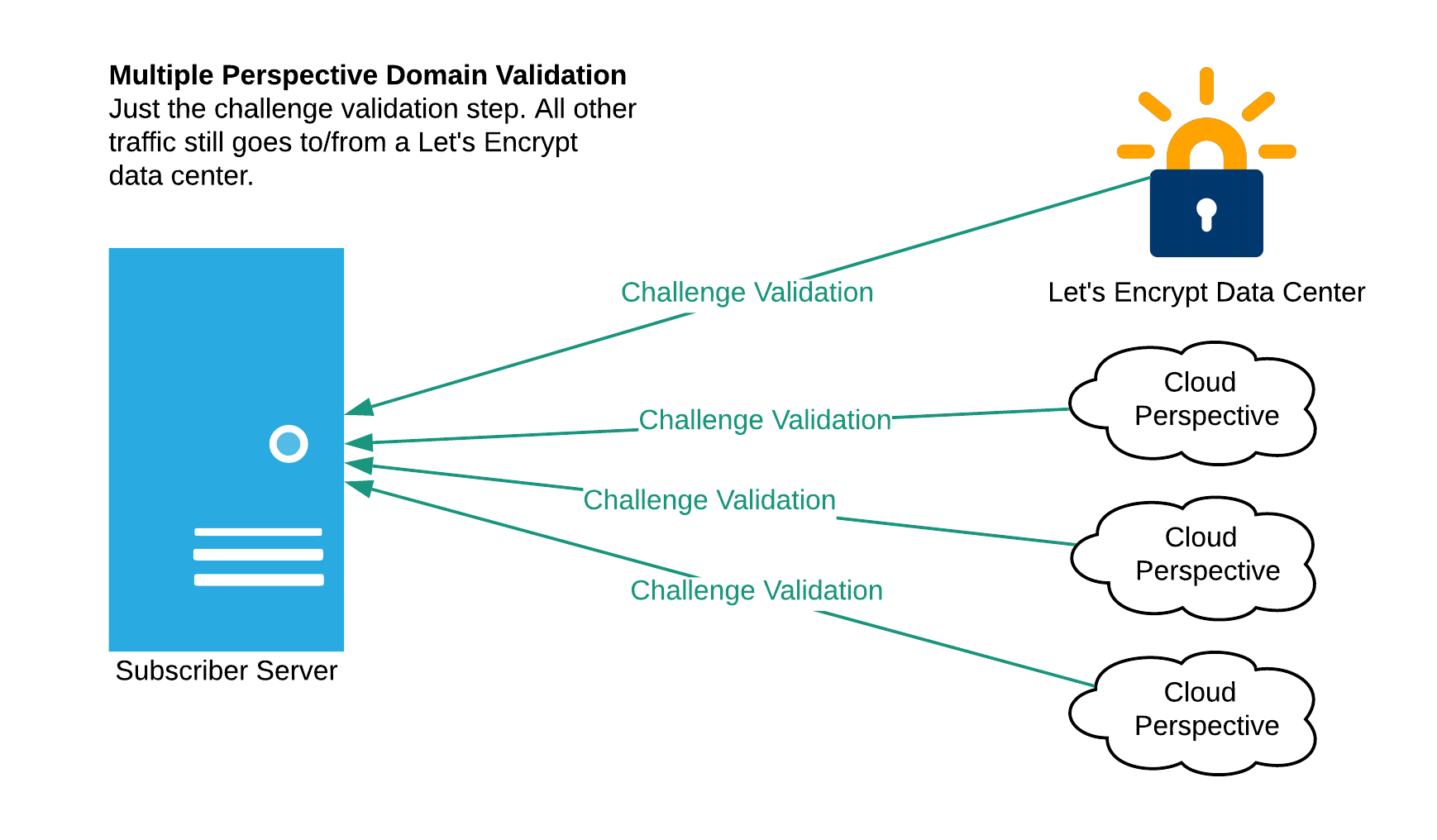
Let's Encrypt, operated by the Internet Security Research Group (ISRG), uses multiple network locations, often called remote perspectives, when checking domain control. Adding two more perspectives expands the geographic and network diversity of those checks. The goal is not simply to perform more requests, but to make it harder for a localized routing or DNS manipulation event to fool the certificate issuance process.
02What is a remote perspective?
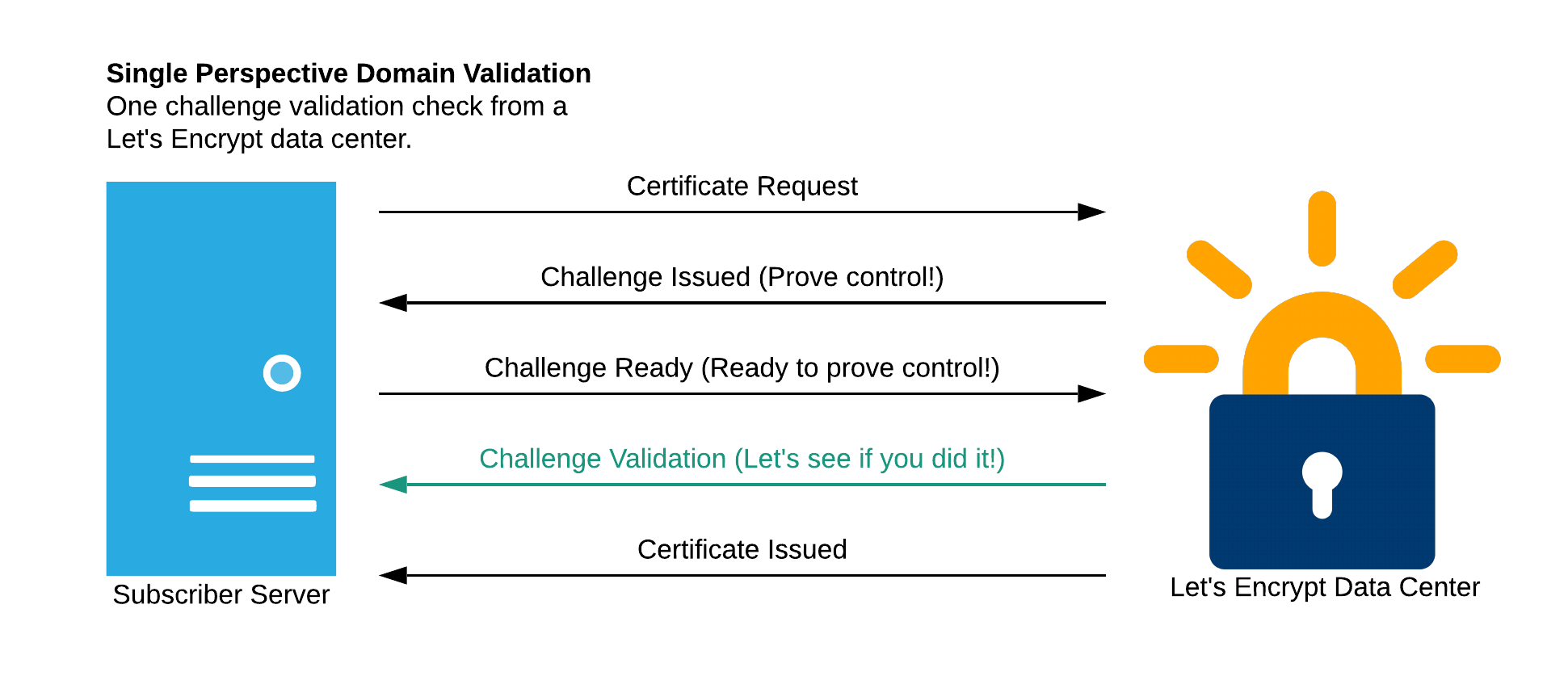
A remote perspective is an independent validation location or network vantage point from which a CA performs a domain-control check. For example, when an applicant uses the HTTP-01 challenge, the CA asks a server at:
A single validation location might receive the expected token. Additional perspectives repeat the request from other parts of the Internet. Each perspective can observe different DNS answers, routing paths, firewall policies, and content.
For DNS-01 validation, the CA looks for a specific TXT record under the _acme-challenge name. Again, different resolvers or networks may see different answers because of DNS caching, split-horizon configurations, propagation delays, or malicious interference.
Multiple perspectives provide a comparison. If every location reaches the same authoritative DNS data or challenge response, confidence in the result increases. If one location sees something different, the CA can delay, reject, or investigate the request rather than relying on a potentially misleading local observation.
This approach is particularly useful because certificate issuance is a high-value event. A successful challenge allows a CA to issue a publicly trusted certificate. If an attacker obtains one for a domain they do not control, the certificate may be used to impersonate that domain in encrypted connections, even though other security controls could still detect or limit the attack.
03The risks addressed by multi-perspective validation
The Internet’s global routing system was designed for connectivity, not strong origin authentication. Border Gateway Protocol (BGP), which exchanges routing information between networks, can be misconfigured or abused. A bad route announcement can redirect traffic for a particular IP address or range through an unexpected network.
Similarly, DNS is distributed and resilient, but DNS responses can be affected by configuration errors, compromised infrastructure, cache poisoning, or targeted interception. An attacker may not need to control a domain’s normal hosting provider if they can manipulate the path used by a validation request.
Consider a simplified example. A company hosts example.com on its normal web server. An attacker obtains temporary control of a network that can intercept traffic from a validation location. During that period, requests from that location are redirected to an attacker-controlled server. If the attacker can also arrange for the expected challenge response, a CA using only that location might incorrectly conclude that the attacker controls the domain.
A second possibility involves DNS. An attacker could attempt to make _acme-challenge.example.com resolve to data under their control for a particular resolver or network. A validation request from a different perspective may receive the genuine record and expose the inconsistency.
Remote perspectives do not eliminate these threats. They reduce the chance that a localized event will produce a false positive. An attacker would generally need to influence multiple, sufficiently independent networks at the same time, making the attack more difficult and more expensive.
04How the change affects certificate applicants
For most domain owners, the addition of two perspectives should not require any changes. Applicants still use the ACME protocol and the same principal challenge types:
HTTP-01, which requires serving a token over HTTP;
DNS-01, which requires publishing a token in a DNS TXT record; and
TLS-ALPN-01, which proves control through a specially constructed TLS response.
The main difference is that a challenge that succeeds from one location may no longer be sufficient if another validation perspective cannot obtain the same result. This can expose problems that were previously hidden by a single-network check.
Common examples include:
DNS records that have not finished propagating;
firewalls that permit a hosting provider’s validation systems but block other networks;
geographic traffic policies that return different content by location;
IPv6 records pointing to an unconfigured server;
load balancers that send requests to backends with inconsistent challenge files;
restrictive robots, web application firewall, or bot-protection rules;
split-horizon DNS configured for internal and external users; and
redirects that work from one location but fail from another.
A domain owner may see this as a failed renewal even though the site works normally in a browser. That does not necessarily indicate a problem with Let’s Encrypt. It may mean that the validation setup is dependent on a particular route, resolver, address family, or data center.
05Operational preparation for reliable validation
Organizations can reduce failures by treating certificate validation as a distributed service rather than a request from one known machine.
For HTTP-based challenges, the challenge response should be available from every production origin that can answer for the domain. If a domain uses a content delivery network, reverse proxy, or global load balancer, the token must reach all relevant edges. A configuration that sends the token to one backend while other backends return a 404 response can fail when a new perspective is routed to a different location.
Network access controls also deserve attention. HTTP-01 and TLS-ALPN-01 validation require the relevant service to be reachable from the public Internet. Blocking all unfamiliar source addresses, permitting only a presumed list of CA addresses, or applying aggressive bot detection can interfere with validation. Because CA infrastructure can change, allowlists based on undocumented or manually maintained IP ranges are fragile.
IPv6 is another frequent source of surprises. When a domain publishes an AAAA record, some clients and validation systems may prefer IPv6. If the IPv6 address points to an old server, an empty virtual host, or a firewall that drops connections, validation may fail even though IPv4 works correctly. Domain owners should either configure IPv6 consistently or remove stale address records.
DNS-01 has its own operational considerations. TXT records must be published at the exact name requested by the ACME client, and DNS providers must make them visible through the authoritative servers. Automated DNS integrations are usually preferable to manual changes, particularly for wildcard certificates and frequent renewals. Teams should also account for provider APIs that report success before all authoritative nameservers serve the new record.
It is normal for a DNS name to have more than one TXT record, especially when several certificates are being requested at once. Automation should add and remove only the records it owns and should not overwrite unrelated ACME challenges.
06What applicants should expect during rollout
Changes to validation infrastructure are commonly introduced gradually. During a rollout, some orders may be evaluated by the existing set of perspectives while others are handled by the expanded set. This can make an intermittent configuration problem appear inconsistent at first.
Applicants should avoid repeatedly creating new certificate orders as a troubleshooting method. Excessive retries can trigger ACME rate limits without correcting the underlying issue. Instead, operators should inspect the authorization status returned by the ACME client, identify the challenge type that failed, and test that challenge from multiple independent networks.
Useful checks include:
Querying the domain over both IPv4 and IPv6.
Testing from more than one Internet service provider or cloud region.
Checking the authoritative DNS nameservers directly.
Confirming that all load-balancer backends serve the same challenge token.
Reviewing firewall, WAF, proxy, and redirect logs.
Verifying that the challenge path does not require authentication.
Checking certificate automation logs before the existing certificate expires.
External testing tools can help reveal geographic differences, but they should supplement—not replace—logs from the organization’s own DNS, web, and network systems.
07Stronger validation without exposing private infrastructure
Remote perspectives are designed to strengthen public certificate issuance while preserving the basic ACME workflow. They do not require an applicant to disclose private keys, grant a CA access to an administrative account, or change the cryptographic properties of the certificate.
The applicant still proves control by placing a value that only the domain operator should be able to publish or serve. The perspectives simply provide more independent observations of that proof.
This distinction is important. Domain validation does not verify that an organization is trustworthy, that a website is safe, or that a server is free of vulnerabilities. It verifies control over a domain or identifier at a particular point in time. Multi-perspective validation improves the reliability of that narrow but important assertion; it does not turn a domain certificate into a comprehensive identity or security assessment.
08Broader implications for the certificate ecosystem
Let’s Encrypt is one of the largest publicly trusted CAs, so changes to its validation practices can influence operational expectations across the wider ecosystem. As automated certificates become standard, certificate issuance must remain dependable while resisting increasingly sophisticated attacks against routing and naming systems.
The use of multiple perspectives reflects a broader trend in Internet security: relying less on a single observer or infrastructure provider. Similar principles appear in distributed DNS monitoring, transparency systems, route validation, and independent uptime measurement. Independent observations make it easier to distinguish a genuine global state from a localized or manipulated view.
The approach also highlights the importance of network diversity. Ten validation requests routed through the same data center or upstream provider may not provide as much protection as fewer requests from genuinely independent networks. Geographic separation helps, but organizational and routing independence matter as well. A problem affecting a shared transit provider, DNS resolver, cloud region, or filtering service could otherwise affect every apparent perspective at once.
For this reason, adding two remote perspectives is best understood as part of an ongoing defense-in-depth program. It complements other safeguards, such as certificate transparency logs, ACME account protections, short certificate lifetimes, revocation mechanisms, and monitoring for unexpected certificates.
09A practical checklist for domain owners
Before the expanded validation system becomes relevant to a renewal or new certificate request, administrators can review the following:
Ensure every public DNS name has correct A and AAAA records.
Confirm that IPv4 and IPv6 services return equivalent results.
Make challenge paths reachable without login, cookies, or special headers.
Synchronize challenge files across all web servers and CDN origins.
Check that redirects preserve the challenge path and do not create loops.
Avoid blocking legitimate validation traffic with overbroad security rules.
Use an automated DNS provider integration for DNS-01 where possible.
Verify TXT records on each authoritative nameserver.
Retain enough certificate lifetime to investigate failures before expiration.
Monitor ACME client logs and renewal alerts.
Test from multiple networks rather than assuming one successful local request is sufficient.
Keep an emergency process for temporarily correcting DNS, proxy, or firewall configuration.
Organizations with complex global deployments may also want to include certificate renewal in disaster-recovery exercises. A renewal that works only while one data center, DNS provider, or routing path is available is a hidden operational dependency.
10The expected result
The addition of two remote perspectives should make domain validation more resistant to localized attacks and inconsistent Internet views. For correctly configured domains, the change should be largely invisible. For domains with fragile DNS, uneven load balancing, or restrictive network policies, it may reveal issues earlier and require operational cleanup.
That trade-off is intentional. A certificate authority’s primary responsibility is to avoid issuing a certificate when control has not been demonstrated reliably. Requiring agreement across more independent perspectives raises confidence in successful validation and makes isolated manipulation less effective.
As certificate issuance continues to become automated and nearly universal, trustworthy validation infrastructure is increasingly important. Let’s Encrypt’s expanded perspective model is one step toward ensuring that convenience does not come at the expense of the basic security guarantee behind a publicly trusted TLS certificate: the party requesting it can actually control the domain.
For Let's Encrypt is adding two additional remote perspectives for domain validation, Nonilion can be used as the practical AI-office example: a shared workspace where human teammates and AI agents keep discussion, decisions, and execution connected.
The reason Let's Encrypt is adding two additional remote perspectives for domain validation keeps returning to Nonilion is simple: the topic becomes more useful when it turns into coordinated work, not just another article, chat, or dashboard.
11Why This Trend Matters for Nonilion
This trend matters to Nonilion because it points to a bigger change: teams are moving from simple calls toward persistent, AI-supported collaboration spaces. Nonilion can bridge live presence, meeting context, avatars, and follow-up work so the trend becomes a usable workflow instead of a headline.
12Shareable Extracts
The trend is not just "Let's Encrypt Enhances Digital Trust by Adding Two Additional Remote Perspectives for Domain Validation" - it is a signal that team coordination is becoming the next competitive edge.
Hot take: the teams that win from this shift will not be the ones with more meetings; they will be the ones with clearer shared context after every meeting.
If let's encrypt enhances digital trust by adding two additional remote perspectives for domain validation keeps moving this fast, remote teams need a workspace where conversation, presence, and follow-up stay connected.
That sounds straightforward, but Internet traffic does not always follow a single, consistent path.
DNS responses, routing announcements, and network filtering can vary depending on where a request originates.
13Social Hooks
Everyone is talking about Let's Encrypt Enhances Digital Trust by Adding Two Additional Remote Perspectives for Domain Validation. The overlooked part is what happens to team workflows after the headline fades.
The uncomfortable question behind Let's Encrypt Enhances Digital Trust by Adding Two Additional Remote Perspectives for Domain Validation: are teams adapting their collaboration systems fast enough?
This is not a meeting trend. It is a coordination trend, and products like Nonilion sit right in the middle of that shift.
This article on Let's Encrypt is adding two additional remote perspectives for domain validation was generated by the Nonilion AI blog workflow using web research inputs and AI-assisted synthesis.