Home/Blog/AI Companies Are Trying to Hide a Staggering Amount of Debt: what the $1.65 trillion figure actually means
human + AI workflows
AI Companies Are Trying to Hide a Staggering Amount of Debt: what the $1.65 trillion figure actually means
AI Companies Are Trying to Hide a Staggering Amount of Debt: what the $1.65 trillion figure may mean The headline is striking for a reason: the analyzed sources describe a large am
12 MIN READ
23 Jul 2026
human + AI workflows
AI Companies Are Trying to Hide a Staggering Amount of Debt: what the $1.65 trillion figure may mean
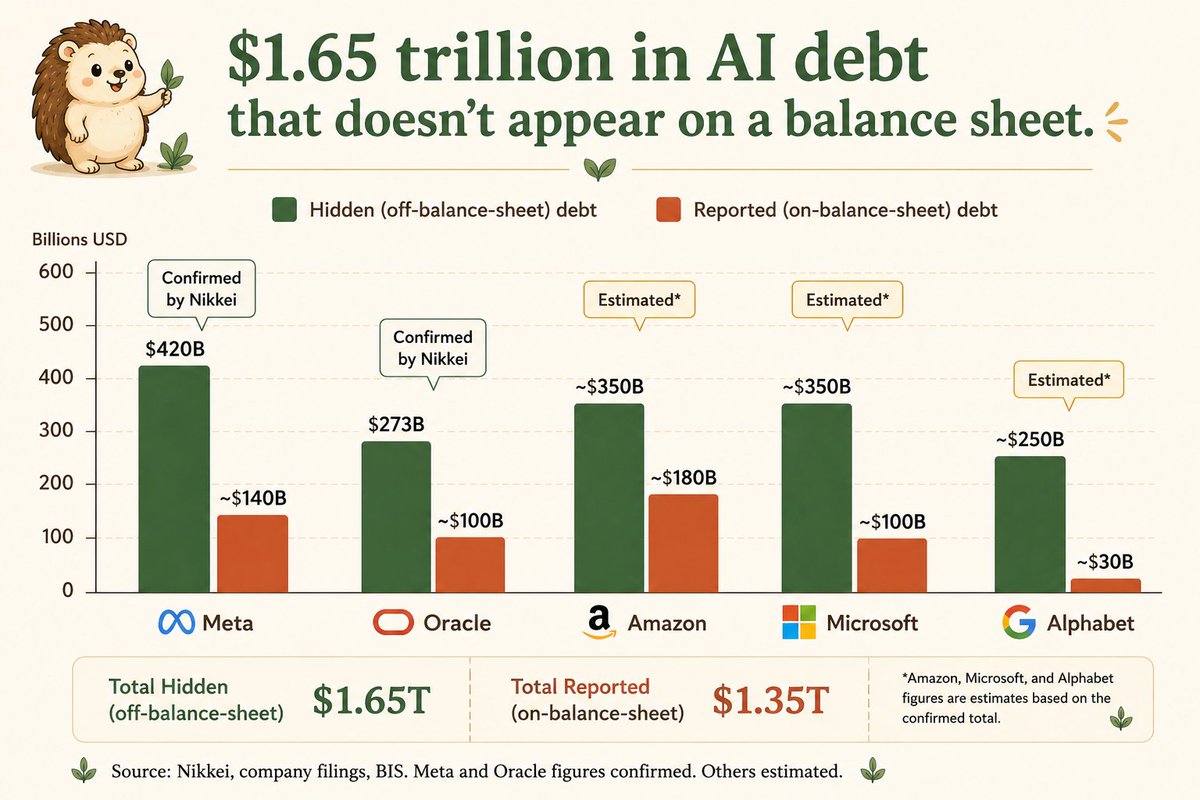
The headline is striking for a reason: the analyzed sources describe a large amount of debt and debt-like obligations tied to AI spending that may not be fully visible on standard balance sheets. The most cited figure is $1.65 trillion, associated in the sources with major U.S. tech companies. For operators, finance teams, and AI buyers, this is a reminder to look beyond headline product claims and pay attention to the commitments behind AI infrastructure.
That matters because AI adoption is not only about model quality or feature velocity. It also depends on the infrastructure underneath the tools, the contracts behind the compute, and the pressure those commitments can place on pricing, hiring, and product reliability. In a world where humans and AI agents share work, those hidden obligations can become an operational concern.
01AI Companies Are Trying to Hide a Staggering Amount of Debt: what the $1.65 trillion figure may mean
Want your team to run this workflow with AI-native execution?
The $1.65 trillion figure appears in multiple analyzed reports and is associated with five major U.S. tech companies: Alphabet, Amazon, Meta, Microsoft, and Oracle. Some sources compare the figure to debt shown on balance sheets, while others describe it as having grown significantly over several years.
The important point is not that the debt is necessarily illegal. The sources describe it as off-balance-sheet or less visible debt tied to AI spending, especially infrastructure buildout. That means the headline number is intended to capture obligations that may be economically meaningful, even if they are not fully visible in the standard debt totals investors usually inspect.
For leaders, the takeaway is simple: the AI boom appears to involve commitments that are harder to see, harder to compare, and harder to factor into decision-making. If the market is focused only on visible debt, it may miss part of the pressure building underneath the AI stack.
02Why hidden AI debt is more than an accounting story — and why operators should care now
This trend matters because debt and long-term commitments can affect the operating environment around AI. If companies are funding AI expansion through opaque commitments, the downstream effects may show up in product pricing, vendor behavior, and investment discipline.
The sources suggest that AI spending is attracting greater scrutiny and that investors may be asking for clearer returns. That can ripple outward in several ways:
Higher financing costs may push vendors to raise prices.
Tighter capital conditions may slow hiring or delay roadmap items.
Pressure to justify AI spend may narrow access to premium infrastructure.
Reliability may become a strategic issue if vendors are stretching to support growth.
For teams that rely on AI tools daily, this is not abstract. It affects whether workflows stay affordable, whether the AI stack remains available, and whether planning assumptions still hold six months from now.
03How off-balance-sheet AI spending works: leases, GPU contracts, cloud commitments, and financing structures
The analyzed sources repeatedly point to data center leases and GPU supply contracts as key drivers of the hidden-debt story. In other words, the spending is not only about buying chips outright; it is also about committing to long-term infrastructure and capacity.
That structure can make the AI buildout look lighter on the balance sheet than it really is. When liabilities sit in contracts, leases, or other financing structures, the company may appear less leveraged than the full economic reality suggests.
A practical way to think about it is this:
A company needs massive compute to support AI growth.
Instead of only recording straightforward debt, it uses commitments tied to infrastructure access.
Those obligations may not show up in the same way as traditional debt.
The result is a cleaner-looking balance sheet and a heavier real-world burden.
The analyzed sources also describe this as a legal accounting approach, but one that can make risk harder for investors to assess. For operators, that means the real question is not just “How much AI is being built?” but “How much future capacity is already spoken for?”
04What the hidden-debt trend may mean for pricing, hiring, product roadmaps, and AI tool reliability
Debt and long-term commitments do not stay hidden forever. They can eventually influence the choices companies make about what to fund, what to delay, and what to pass on to customers.
Here is where the operational impact may become visible:
Pricing: If AI infrastructure costs rise, vendors may have to charge more for access, usage, or enterprise tiers.
Hiring: Capital pressure can slow headcount growth, especially in roles tied to long-term bets.
Product roadmaps: Teams may prioritize monetizable features over experimental ones.
Tool reliability: If vendors are under pressure to scale quickly, service quality can become uneven.
This is why the hidden-debt story is relevant to everyday workflow design. Teams that build around AI need to know whether their tools are stable, funded, and likely to remain available under changing market conditions.
For a virtual AI office like Nonilion, that means keeping human work and AI agent work visible in one shared operating rhythm. When vendors, costs, or capacity shift, the value is not just in automation — it is in coordination, async execution, and clear ownership.
05The future-of-work risk: when AI infrastructure pressure reaches everyday teams and workflows
The future-of-work angle is easy to miss if the conversation stays at the investor level. But the sources suggest a real possibility: if AI demand stays strong, the costs of supporting that demand may eventually reach the people using AI every day.
That can happen in several ways. Teams may face slower access to preferred tools, reduced usage limits, or more expensive workflows. Leaders may also feel pressure to prove ROI faster, which can change how AI is deployed across departments.
For distributed teams, the risk is not only budgetary. It is operational. When AI becomes more expensive or less predictable, teams need a way to preserve continuity without depending on a single vendor assumption.
That is where human + AI collaboration becomes a resilience strategy. If AI agents are handling repeatable work, and humans are managing exceptions, approvals, and judgment calls, the team can adapt more easily when the market changes.
06What this means for AI offices like Nonilion: coordinating humans and AI agents when the market gets less predictable
This is the point where the topic connects directly to AI offices. In an environment shaped by hidden debt, the value of an AI office is not only speed — it is visibility.
Nonilion fits here as a practical example of an AI office where humans and AI agents work together in one shared workspace. If AI costs rise or access tightens, the advantage is having workflows that do not collapse when a single tool changes. Meeting follow-ups, async execution, task routing, and workflow automation can keep moving because the system is designed around coordination, not just consumption.
That matters in uncertain markets because AI agents can help keep work moving, but humans still need to supervise priorities, exceptions, and business judgment. In other words, the office needs both automation and ownership.
A resilient AI office should be able to answer three questions quickly:
What work is being done by AI agents?
What work still needs human review?
What happens if a vendor slows down or gets more expensive?
Those questions become more important when the infrastructure behind AI is under financial strain.
07How leaders should respond: a practical checklist for finance, ops, and AI buyers
Leaders do not need to predict the entire AI market to respond well. They need to make commitments visible, test assumptions, and reduce dependence on any one cost path.
Practical checklist
Review where AI costs are direct versus embedded in contracts or usage commitments.
Map which workflows depend on a single vendor or a single model provider.
Separate experimental AI spend from core operational AI spend.
Ask vendors how pricing, capacity, and reliability could change under tighter market conditions.
Build fallback workflows for critical tasks that cannot pause if access changes.
Track which parts of the work are handled by humans, and which are handled by AI agents.
For finance teams, the goal is clearer exposure. For ops teams, the goal is continuity. For AI buyers, the goal is to avoid mistaking short-term abundance for long-term stability.
08Scenario planning for distributed teams: if AI costs rise, access tightens, or vendors slow down
Scenario planning is especially useful for distributed teams because their workflows are already spread across time zones, tools, and responsibilities. When AI is part of the operating layer, teams should plan for at least three scenarios.
Scenario 1: AI costs rise
If pricing increases, teams may need to reduce nonessential usage, prioritize high-value workflows, and shift routine tasks to lower-cost processes.
Scenario 2: access tightens
If usage limits or capacity constraints appear, teams should know which tasks are mission-critical and which can wait. This is where async coordination matters most.
Scenario 3: vendors slow down
If a provider delays new features or support, teams need clear ownership so humans can step in without losing context.
The best defense is not over-optimism. It is operational design. AI offices that document work, assign ownership, and keep human review in the loop will be better prepared when market conditions become less predictable.
09Where the real advantage may come from: execution discipline, visible ownership, and human + AI collaboration
The hidden-debt story is ultimately a reminder that scale without clarity creates risk. The companies building AI infrastructure may be carrying obligations that are hard to see, and the teams using AI may be assuming stability that the market cannot always guarantee.
The real advantage may belong to organizations that execute with discipline. That means knowing what is automated, what is owned, and what can flex if the environment changes.
For Nonilion, that is the core idea of an AI office: humans and AI agents working together in a shared system where work remains visible, coordinated, and resilient. In a market shaped by opaque AI funding and rising pressure, that kind of operating model can be a practical way to stay adaptable.
10Key Takeaways
Based on the analyzed sources, major U.S. tech companies are associated with about $1.65 trillion in hidden or off-balance-sheet AI debt.
The debt story may affect pricing, hiring, product roadmaps, and tool reliability.
Data center leases, GPU supply contracts, and financing structures are central to how this spending stays less visible.
Distributed teams should plan for rising costs, tighter access, and vendor slowdowns.
AI offices like this platform can help by keeping human + AI collaboration visible, coordinated, and adaptable.
This trend matters to Nonilion because it points to a bigger change: teams are moving from simple calls toward persistent, AI-supported collaboration spaces. Nonilion can bridge live presence, meeting context, avatars, and follow-up work so the trend becomes a usable workflow instead of a headline.
12Shareable Extracts
The trend is not just "AI Companies Are Trying to Hide a Staggering Amount of Debt: what the $1.65 trillion figure actually means" - it is a signal that team coordination is becoming the next competitive edge.
Hot take: the teams that win from this shift will not be the ones with more meetings; they will be the ones with clearer shared context after every meeting.
If ai companies are trying to hide a staggering amount of debt: what the $1.65 trillion figure actually means keeps moving this fast, remote teams need a workspace where conversation, presence, and follow-up stay connected.
The most cited figure is $1.65 trillion, associated in the sources with major U.S.
For operators, finance teams, and AI buyers, this is a reminder to look beyond headline product claims and pay attention to the commitments behind AI infrastructure.
13Social Hooks
Everyone is talking about AI Companies Are Trying to Hide a Staggering Amount of Debt: what the $1.65 trillion figure actually means. The overlooked part is what happens to team workflows after the headline fades.
The uncomfortable question behind AI Companies Are Trying to Hide a Staggering Amount of Debt: what the $1.65 trillion figure actually means: are teams adapting their collaboration systems fast enough?
This is not a meeting trend. It is a coordination trend, and products like Nonilion sit right in the middle of that shift.
This article on AI Companies Are Trying to Hide a Staggering Amount of Debt was generated by the Nonilion AI blog workflow using web research inputs and AI-assisted synthesis.